Labour Department - Chapter 6 – Employees’ Rights and Benefits
The Programme of Employees’ Rights and Benefits
www.labour.gov.hk/eng/erb/content.htm
The objective of the Employees’ Rights and Benefits Programme is to improve and safeguard employees’ rights and benefits in an equitable manner. Our aim is to progressively enhance employment standards in a way which is commensurate with the pace of Hong Kong’s economic and social developments and which takes into account the interests of employers and employees. We achieve this by:
- setting and refining employment standards in consultation with the Labour Advisory Board;
- ensuring compliance with statutory and contractual terms and conditions of employment through inspection of workplaces, investigation into suspected breaches of the statutory provisions and prosecution of offenders;
- processing employees’ compensation claims;
- processing applications for ex gratia payment from the Protection of Wages on Insolvency Fund (PWIF);
- administering the Reimbursement of Maternity Leave Pay (RMLP) Scheme;
- administering the Subsidy Scheme for Abolition of MPF Offsetting Arrangement (SSA);
- maintaining close partnership with statutory bodies set up for protecting the rights and benefits of employees; and
- providing customer-oriented information to ensure that employees and employers know their rights and obligations.
6.2 The principal legislation administered by this programme area includes the Employees’ Compensation Ordinance (ECO), the Pneumoconiosis and Mesothelioma (Compensation) Ordinance (PMCO), the Occupational Deafness (Compensation) Ordinance (ODCO), the Employees Compensation Assistance Ordinance (ECAO), the Employment Ordinance (EO) and its subsidiary Employment of Children Regulations and Employment of Young Persons (Industry) Regulations, the Minimum Wage Ordinance (MWO), the Protection of Wages on Insolvency Ordinance (PWIO) as well as Part IVB of the Immigration Ordinance.
6.3 The ECO establishes a no-fault, non-contributory employees’ compensation system so that individual employers are liable to pay compensation for work-related injuries and fatalities. It requires all employers to possess valid insurance policies to cover their liabilities under the laws (including the common law).
6.4 The PMCO provides for compensation payable to persons who suffer from pneumoconiosis and/or mesothelioma and family members of persons who die of these diseases. Compensation is paid from the Pneumoconiosis Compensation Fund, which is administered by the Pneumoconiosis Compensation Fund Board.
6.5 The ODCO provides for compensation payable to persons who suffer from noise-induced deafness by reason of employment in specified noisy occupations. Compensation is paid from the Occupational Deafness Compensation Fund, which is administered by the Occupational Deafness Compensation Board.
6.6 The ECAO establishes the Employees Compensation Assistance Fund to provide assistance payment to injured employees and family members of deceased employees who are unable to receive their entitlements for work-related injuries and fatalities from employers and insurers. The fund is administered by the Employees Compensation Assistance Fund Board.
6.7 The EO is the main piece of legislation governing conditions of employment. The Employment of Children Regulations made under the EO prohibit the employment of children below the age of 15 in industrial undertakings and regulate the employment of children who have attained the age of 13 but under 15 in non-industrial establishments. The Employment of Young Persons (Industry) Regulations set out requirements on the working time arrangements for young persons employed in the industrial sector and prohibit their employment in dangerous trades.
6.8 The MWO establishes a Statutory Minimum Wage (SMW) regime which provides a wage floor with a view to forestalling excessively low wages, but without unduly jeopardising Hong Kong’s labour market flexibility, economic growth and competitiveness or leading to significant adverse impact on the employment opportunities of vulnerable workers. Failure to pay the SMW amounts to a breach of the wage provisions under the EO.
6.9 The PWIO establishes the PWIF to provide timely relief in the form of ex gratia payment to employees affected by their insolvent employers.
6.10 The Labour Department (LD) also administers Part IVB of the Immigration Ordinance to assist in combating illegal employment in order to protect the employment opportunities of local workers.
Our Work and Achievements in 2025
Key Indicators of Work
6.11 We sustained our efforts to safeguard the rights and benefits of employees through various activities in 2025. Some key indicators of work of this programme area are shown in Appendix 6.1.
Improvement to Employees’ Benefits
6.12 The SMW rate under the MWO was increased by 5.3% from $40 to $42.1 per hour with effect from 1 May 2025.
6.13 With effect from 17 April 2025, the ECO, PMCO and ODCO were amended to increase the amounts of a total of 18 compensation items payable in cases involving work accidents or prescribed occupational diseases.
Proactive Efforts to Combat Wage Defaults
6.14 In 2025, the LD continued to adopt a proactive strategy to tackle the problem of non-payment of wages at source through enhancing publicity and promotion, taking enforcement and prosecution actions, and making use of the early warning system set up in collaboration with trade unions to gather relevant intelligence. We also proactively monitored selected sectors and establishments with a view to forestalling and detecting cases of wage default at an early stage and intervening early to tackle the problem.
6.15 We continued to take enforcement and prosecution actions against employers and responsible individuals of companies for wage offences. We conducted territory-wide inspections of workplaces to detect wage offences. Labour inspectors actively interviewed employees during inspections and conducted investigation speedily into the suspected offences. Prosecutions were taken out whenever sufficient evidence was available.
6.16 During the year, the LD secured 663 convicted summonses for wage offences and 75 convicted summonses for defaults of awards made by the Labour Tribunal (LT) or the Minor Employment Claims Adjudication Board (MECAB). Two company directors were ordered to perform community service. These sentences disseminated a strong message to employers and company responsible individuals on the seriousness of defaults of wages and awards made by the LT or the MECAB.
Vigorous Enforcement to Protect Employees’ Rights and Benefits
6.17 The LD continued vigorous enforcement efforts to ensure that the statutory rights of employees under labour legislation were well protected.
6.18 In 2025, Labour Inspectors carried out 153 370 workplace inspections of establishments in various trades to enforce labour laws (Appendix 6.2). A total of 1 792 complaints were handled in the year.
6.19 To safeguard employees’ entitlement to the SMW, we also conducted proactive workplace inspections of various establishments and mounted targeted enforcement campaigns for low-paying sectors. In the year, 58 401 inspections were conducted to check compliance with the MWO.
6.20 We conducted inspections and trade-targeted operations to enforce the ECO’s compulsory requirement of taking out employees’ compensation insurance policy. In the year, a total of 111 002 inspections were conducted to enforce the statutory requirement.
6.21 We continued to work closely with government departments in monitoring their service contractors to ensure that non-skilled employees of the contractors enjoyed their rights and benefits. A total of 1 261 inspections were conducted to the workplaces of such workers and 4 115 workers were interviewed to check contractors’ compliance with labour laws.
6.22 To ensure employers’ compliance with the conditions under the Enhanced Supplementary Labour Scheme (ESLS), we investigated 194 complaints and cases on suspected irregularities under the scheme. Items investigated included employers displacing local employees with imported workers and work arrangements of imported workers.
Processing Employees’ Compensation Cases and Improving Work Injury Protection for Employees
6.23 Under the current no-fault employees’ compensation system, compensation is payable to injured employees or family members of deceased employees for any work-related injuries or fatalities. Claims for compensation involving fatality are determined by the courts or by the Commissioner for Labour under the improved settlement mechanism introduced in August 2000.
6.24 In 2025, 39 545 employees’ compensation cases, including 12 301 minor cases which involved sick leave of not exceeding three days, were received. At year-end, among the 27 244 fatal cases or non-fatal cases involving sick leave exceeding three days, 16 590 cases were settled. The amount of employees’ compensation involved was $275 million. The remaining cases were pending expiry of employees’ sick leave, assessment of permanent incapacity or court judgment (Appendices 6.3 and 6.4).
6.25 The LD enhanced the Claims Support Services through dedicated follow-up, early intervention and proactive contact to facilitate timely resolution of differences between employers and employees in employees’ compensation cases.
6.26 The Task Force on Improving Work Injury Protection for Employees in High-risk Industries (Task Force) coordinated by the LD continued to implement improvement measures including stepping up the publicity and promotion of taking out adequate employees’ compensation insurance coverage by employers, enhancing the case processing of employees’ compensation claims, shortening the waiting time of injured employees for work injury assessments and strengthening training on occupational medicine. The Task Force will continue to discuss and implement other improvement measures.
Briefings and Promotional Campaigns
6.27 In 2025, the LD arranged 41 and 173 briefings for employers/employment agencies and imported workers respectively under the ESLS to publicise the rights and obligations of the parties concerned.
6.28 Extensive publicity campaigns were launched to publicise our complaint telephone hotline (2815 2200) through the LD’s homepage, periodic publications of major trade union federations, second pouch boxes of Hongkong Post, popular websites and mobile applications, etc. to encourage members of the public to report suspected breaches of employment rights.
6.29 We organised a wide range of publicity activities to promote the SMW rate and the MWO during the year. These activities included broadcasting TV and Radio APIs, distributing and displaying leaflets and posters, holding seminars, publishing feature articles in newspapers, providing online interactive games on the LD’s website, and placing advertisements through various channels such as mobile applications and online platforms.
 MWO Seminar.jpeg)
Seminar on the Minimum Wage Ordinance
 MWO banner.jpeg)
An outdoor banner was displayed to promote the Statutory Minimum Wage
6.30 We continued to promote employers’ statutory obligations on timely reporting of work accidents and taking out employees’ compensation insurance policies through broadcasting APIs, placing advertisements through various channels (such as newspapers, journals of workers’ unions and trade associations and public transport), publishing feature articles in newspapers, distributing leaflets and displaying posters, as well as holding seminars on the ECO.
 ECD Seminar 2025.jpg)
Seminar on the Employees’ Compensation Ordinance
 Poster at second pouch box (JPG 1MG).jpg)
A poster was displayed on a second pouch box to promote the message of taking out employees’ compensation insurance policy
RMLP Scheme
6.31 In tandem with extension of statutory maternity leave from 10 weeks to 14 weeks since 2020, the LD rolled out the RMLP Scheme to fully reimburse employers for the additional statutory maternity leave pay, subject to a cap of $80,000 per employee.
6.32 The RMLP Scheme runs a one-stop online portal “Reimbursement Easy Portal” (www.rmlps.gov.hk). Registered employers can access a wide range of online services, including submitting applications, checking application progress, making enquiries and receiving latest information on the RMLP Scheme. In 2025, the RMLP Scheme received 7 531 applications and approved 7 670 applications with reimbursement of $207 million.
SSA
6.33 To tie in with the implementation of the abolition of MPF offsetting arrangement, the SSA started receiving applications on 1 May 2025. After paying SP/LSP to employees in accordance with the EO, eligible employers can apply for subsidies to cover the expenses on SP/LSP in respect of their employees’ employment period from 1 May 2025 onwards. Employees who receive less in aggregate benefits than they would have received if the MPF offsetting arrangement had not been abolished may also apply for subsidies to make up for the shortfall in aggregate benefits.
6.34 The LD launched a thematic website “TransitionEase Portal” (www.offsettingsubsidy.gov.hk) to provide a “one-stop” platform for employers to submit subsidy applications, upload supporting documents, check application progress, receive result notifications, make enquiries and obtain the latest information on the SSA. Employers and employees can also make use of the calculating tool “EasyCal” on the website to calculate the amounts of SP/LSP and Government subsidy. From May to December 2025, the SSA received 12 787 applications and approved 9 361 of them, with subsidies disbursed amounting to around $16 million.
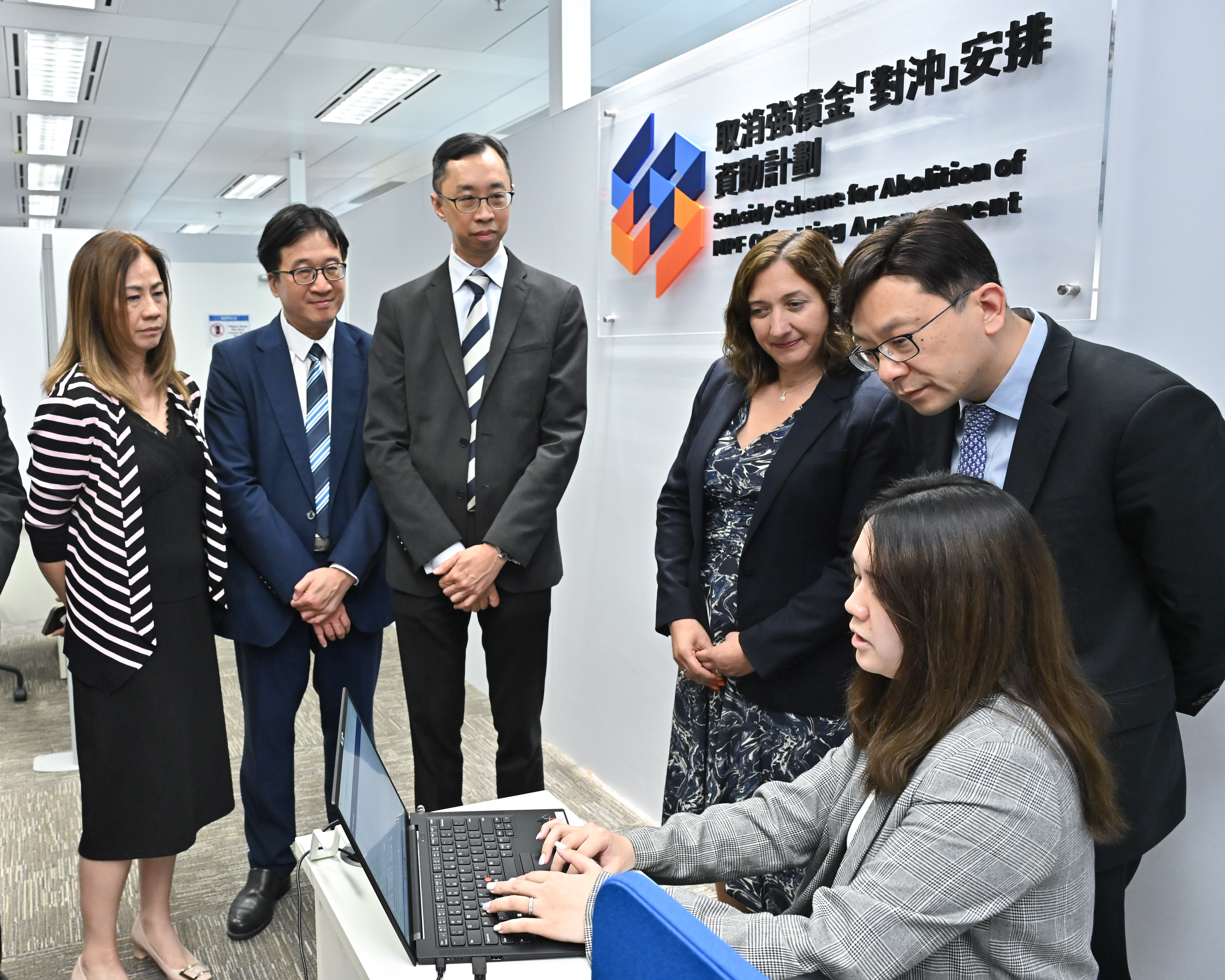
To tie in with the implementation of the abolition of the Mandatory Provident Fund (MPF) offsetting arrangement, the Labour Department launched the 25-year Subsidy Scheme for Abolition of MPF Offsetting Arrangement to share out the severance payment/long service payment expenses of employers after the abolition
Partnership with Statutory Bodies
6.35 We maintain close partnership with various statutory bodies that have been set up for implementing the different schemes for the protection of the rights and benefits of employees.
Protection of Wages on Insolvency Fund Board (PWIFB)
6.36 The PWIFB established under the PWIO is responsible for administering the PWIF. Employees who are owed wages, wages in lieu of notice, severance payment, pay for untaken annual leave and pay for untaken statutory holidays by their insolvent employers may apply for ex gratia payment from the PWIF in accordance with the PWIO. The PWIF is mainly financed by a levy on business registration.
6.37 The LD provides administrative support to the PWIFB, verifies applications and approves ex gratia payment from the PWIF. In 2025, we received 5 842 applications and processed 5 917 applications from employees who were owed wages and other statutory entitlements due to business cessation and sought relief from the PWIF, with ex gratia payment of $267 million made. A breakdown of applications received by economic sector is shown in Appendix 6.5.
6.38 By providing a safety net for employees affected by business closures, the PWIF plays an important role in maintaining good labour relations and social stability. Both the LD and the PWIFB attach great importance to protecting the PWIF from possible abuse. To this end, stringent vetting procedures are in place to process all applications. An inter-departmental task force has been formed by representatives of the LD, the Commercial Crime Bureau of the Hong Kong Police Force and the Official Receiver’s Office to take concerted actions against suspected fraudulent cases.
Pneumoconiosis Compensation Fund Board (PCFB)
6.39 The PCFB is established under the PMCO to provide compensation to persons suffering from pneumoconiosis and/or mesothelioma and family members of persons who die of these diseases. The PCFB is financed by a levy collected from the construction and quarrying industries. Under the PMCO, the LD is responsible for determining whether an applicant is entitled to compensation. As at end-2025, 1 387 eligible persons were receiving compensation in the form of monthly payments from the PCFB. In the year, the PCFB made a total compensation payment of $299 million.
Occupational Deafness Compensation Board (ODCB)
6.40 Established under the ODCO, the ODCB provides compensation for persons who suffer from noise-induced deafness by reason of employment in specified noisy occupations and financial assistance for their purchase, fitting, repair or maintenance of hearing assistive devices. The ODCB also launches educational and publicity programmes for the prevention of occupational deafness, and provides rehabilitation programmes for those suffering from occupational deafness. In 2025, the ODCB approved 250 applications for compensation with a total compensation payout at $23.7 million and 928 applications for payment of expenses on hearing assistive devices with a total payout at $11.15 million. The ODCB also provided 722 rehabilitation programmes for people with hearing impairment caused by their employment in specified noisy occupations.
Employees Compensation Assistance Fund Board (ECAFB)
6.41 Set up under the ECAO, the ECAFB is responsible for administering the Employees Compensation Assistance Fund which provides assistance payment to eligible injured employees and family members of deceased employees who are unable to receive their entitlements for work-related injuries and fatalities from employers and insurers after exhausting all legal and financially viable means of recovery. In 2025, the ECAFB approved 64 applications, leading to payment of $44.31 million.