Labour Department - Chapter 4 – Safety and Health at Work
The Programme of Safety and Health at Work
www.labour.gov.hk/eng/osh/content.htm
The Occupational Safety and Health Branch is responsible for the promotion and regulation of safety and health at work. The objective of the Programme of Safety and Health at Work is to ensure that risks to people’s safety and health at work are properly managed and reduced to the minimum through the multi-pronged strategy of inspection and enforcement, education and training, publicity and promotion as well as application of innovative technologies. More specifically, we achieve the objective by:
- providing a legislative framework to safeguard safety and health at work;
- enforcing compliance with the Occupational Safety and Health Ordinance (OSHO), the Factories and Industrial Undertakings Ordinance (FIUO), the Boilers and Pressure Vessels Ordinance (BPVO) and their subsidiary regulations through inspection of workplaces to ensure that the requirements are complied with;
- investigating accidents and occupational health problems at workplaces and giving advice to employers and employees on how to reduce existing workplace hazards;
- offering advice to owners in the design and layout of workplaces, and in the implementation of safety programmes in workplaces;
- providing to employers, employees and the general public appropriate information and advice to promote knowledge and understanding of OSH; and
- organising promotional programmes and training courses to enhance safety awareness of the workforce.
4.2 The OSHO protects employees’ safety and health at work generally in all branches of economic activities. It is a piece of enabling legislation that empowers the Commissioner for Labour to make regulations prescribing standards for general working environment as well as specific safety and health aspects at work.
4.3 The FIUO regulates safety and health at work in industrial undertakings, which include factories, construction sites, cargo and container handling areas, as well as catering establishments.
4.4 The BPVO aims at regulating the standards and operation of boilers and pressure vessels, including steam boilers, steam receivers and air receivers.
Our Work and Achievements in 2025
Work Safety Performance
4.5 Through the concerted efforts of all parties concerned, including employers, employees, contractors, safety practitioners, and the Government and public sector organisations, Hong Kong’s work safety performance has been improving.
4.6 The number of occupational injuries in all workplaces in 2025 stood at 26 365, whereas the number in 2016 was 35 768. The injury rate per thousand employees was 9.1 in 2025, and the rate in 2016 was 11.9. The number of industrial accidents for all sectors was 6 486, and the number in 2016 was 10 883. The accident rate per thousand workers for all sectors was 11.1, and the rate in 2016 was 17.1.
4.7 In 2025, there were 2 425 industrial accidents in the construction industry, and the number in 2016 was 3 720. The accident rate per thousand workers in 2025 was 21.3, and the rate in 2016 was 34.5.
Occupational Diseases
4.8 In 2025, there were 332 confirmed occupational disease and gas poisoning cases. The most common occupational diseases were occupational deafness, silicosis, mesothelioma and tenosynovitis of the hand or forearm.
4.9 For more statistics on the OSH, please visit the webpage: www.labour.gov.hk/eng/osh/content10.htm.
Key Indicators of Work
4.10 Some key indicators of work of this programme area are shown in Appendix 4.1.
Raising Penalties for OSH Legislation
4.11 The Occupational Safety and Occupational Health Legislation (Miscellaneous Amendments) Ordinance 2023 took effect on 28 April 2023 to raise the overall penalties for OSH offences, so as to enhance deterrent effect of legislation, prompting relevant duty holder to pay more attention to the precautionary measures for protection of employees’ OSH. The LD has been paying attention to whether the court’s sentences can achieve the expected deterrent effect and depending on the circumstance of the case to consider the application for review or appeal in respect of sentencing if necessary.
Inspection and Enforcement
4.12 To ensure safety and health at work, we inspect workplaces, monitor health hazards, investigate work accidents and occupational diseases, register and inspect boilers and pressure equipment and advise on measures to control hazards and prevent accidents.
4.13 We conduct promotional visits to give advice to employers on the prevention of accidents and encourage them to proactively adopt a self-regulatory approach in managing risks at the workplace. We also conduct enforcement inspections to various workplaces to ensure that duty holders have observed relevant statutory requirements stipulated in safety legislation. We adopt a risk-based approach to adjust the intensity of inspection and enforcement efforts from time to time to effectively combat violations.
4.14 In 2025, we continued to place workplaces with poor safety performance under close surveillance. Improvement notices or suspension notices were issued when necessary to secure speedy rectification of irregularities, or to remove imminent risks to lives. In 2025, we also conducted 13 special enforcement operations targeting specific workplace hazards or workplaces with higher-risk work processes, including new works; RMAA works; lifting operations; electrical works; bamboo scaffolding; sea-based construction works; the catering industry; waste management work; the logistic, cargo and container-handling industries as well as fire safety of building maintenance work sites with large-scale scaffolding erected. In these 13 operations, a total of 15 698 workplaces were inspected, with 1 454 improvement notices and 46 suspension notices issued to duty holders, and 678 prosecutions initiated. Besides, we launched 42 in-depth surprise inspections to work sites with higher-risk processes or poor safety performance. A total of 1 243 suspension/improvement notices were issued and 308 prosecutions were initiated. In order to enhance safety performance of public work projects, representatives of the LD participated in 476 site safety management committee meetings of public work projects and provided safety advice, particularly on work processes with relatively high risk, to the contractors and relevant duty holders.
4.15 We conduct investigations into complaints concerning unsafe conditions or malpractices in workplaces. In 2025, we handled 276 complaints lodged by workers and initiated 26 prosecutions arising from investigation of these cases. Through the intelligence reporting system on unsafe RMAA works developed with various strategic partners, a total of 18 969 complaint/referral cases were received. As a result of the follow-up inspections on these referral cases, we issued 383 suspension/improvement notices and took out 158 prosecutions.
4.16 To enable the conduct of inspections in a more targeted manner, the LD’s online OSH complaint platform facilitates employees and members of the public to report unsafe working conditions using mobile electronic devices, so that the LD can conduct prompt follow-up actions. In 2025, the LD received a total of 1 343 OSH complaints through the platform. A total of 26 suspension notices and 175 improvement notices were issued, and 92 prosecutions were/will be taken out by the LD upon discovery of breaches of OSH legislation from the above complaints.
4.17 In 2025, the LD continued to collaborate with the property management sector to implement the referral mechanism for RMAA works carried out in individual units of estates. Responsible property management personnel would notify the LD prior to the commencement of some high-risk works (e.g. truss-out scaffolding works at external walls), thus enabling the LD to conduct targeted safety inspections in a timely manner.
4.18 In 2025, the LD continued to carry out enforcement operations and publicity campaigns targeting workplaces with a higher risk of heat stroke. These workplaces include construction sites, outdoor cleansing workplaces, horticulture workplaces and container yards. In the enforcement operation from May to October, we conducted a total of 23 054 surprise inspections and issued 708 warnings.
4.19 The Commissioner for Labour, as the Boilers and Pressure Vessels Authority, recognises competent inspection bodies to assess and inspect new pressure equipment during manufacturing. In addition, the LD conducts examinations, monitors courses for training of competent persons and issues certificates of competency to qualified candidates as competent persons for various types of boilers and steam receivers. In 2025, 458 applications for certificates of competency were processed, with 452 certificates issued/endorsed. We also advised the Fire Services Department on matters related to the approval and preliminary inspections of pressurised cylinders and storage installations for compressed gas.
4.20 As at end-2025, the LD recorded a total of 251 393 workplaces, including 38 727 construction sites. In the year, 148 016 inspections were conducted under the OSHO, the FIUO and their subsidiary regulations. As a result, 31 873 warnings and 5 720 suspension or improvement notices were issued. Besides, 4 672 inspections were made under the BPVO. 2 677 warnings were given and 15 prohibition orders on the use and operation of boilers and pressure vessels were issued. We also carried out 19 308 and 3 207 investigations on work accidents and suspected occupational diseases/occupational health problems respectively. We also conducted 6 375 occupational hygiene surveys on workplace health hazards.
Education and Training
4.21 We provide training-related services to employers, employees and relevant parties to foster an OSH culture among the working population. They include provision of training courses, recognition of Mandatory Safety Training (MST) courses and registration of safety officers and safety auditors.
4.22 In 2025, we organised 571 safety and health training courses related to relevant legislation for 2 202 persons and 236 tailor-made talks to individual industries or organisations for another 49 789 persons. We also recognised six mandatory basic safety training courses (commonly known as “green card” courses) for construction and container-handling work, one MST course for confined spaces operation, two MST courses for operators of cranes and two MST courses for operators of loadshifting machines. We also continued to refine the MST courses and launched a holistic review of the existing MST system. In‑depth studies are currently underway to improve the overall quality of the courses, ensure that the training keep pace with the latest OSH risk trends, meet the practical needs of trainees, and strengthen the monitoring of the performance of course providers and trainers of the MST courses. Meanwhile, we continued to conduct different modes of monitoring inspections, including surprise inspections and covert inspections which involved inspecting officers in the guise of course participants, to ensure that the courses were delivered in accordance with the course contents.
4.23 In 2025, we registered 316 and 87 persons as safety officers and safety auditors respectively. As at the end of the year, there were 4 699 safety officers with valid registration and 1 818 registered safety auditors. Furthermore, a total of 917 applications for renewal or revalidation of registration as safety officers were approved in 2025.
4.24 Occupational health education raises employers’ and employees’ awareness of the prevention of occupational health hazards and occupational diseases. In 2025, we organised a total of 1 172 health talks for over 64 220 participants. Apart from public talks, we also conducted outreaching health talks at the workplaces of individual organisations. These health talks covered various occupations with more than 40 different topics such as Prevention of Heat Stroke at Work, Safety and Health for Confined Space Works, Occupational Health for Office Workers, Manual Handling Operations and Prevention of Back Injuries, Occupational Health for Cleansing Workers, Prevention of Lower Limb Disorders and Occupational Health in Catering Industry.
4.25 The LD uploaded Work Safety Alerts and Systemic Safety Alerts on the LD’s website respectively to help raise the safety awareness of employers, contractors and workers and to urge Registered Safety Officers and Registered Safety Auditors to apply safety management principles in exercising their statutory functions to advise their employers/clients to fulfill their safety responsibilities and render the necessary assistance. Work Safety Alerts summarised recent fatal and serious work accidents, and highlighted general safety precautionary measures whereas Systemic Safety Alerts provided accident prevention measures arising from the major systemic problems. In 2025, we continued to produce Work Safety Alerts in the form of animation videos to enable the industry to better comprehend how accidents happened and the necessary precautionary measures to be taken for preventing recurrence of similar accidents. Two animation videos titled “Trapped by the Tail Lift of a Lorry” and “Trapped between a Mobile Elevating Work Platform and a Sprinkler Pipe”, were uploaded to the LD’s website and widely disseminated through different channels. Furthermore, the LD continued to translate sub-titles of the Work Safety Alerts animation videos into different languages (including Hindi, Nepali, Tagalog and Urdu) to enable construction workers of diverse races to comprehend the OSH information.
Publicity and Promotion
4.26 We held a series of promotional campaigns in 2025 to heighten safety awareness among employers and employees and to cultivate a positive safety culture at the workplaces, with some jointly organised with relevant stakeholders such as the OSHC, trade associations, workers’ unions and other government departments.
4.27 In 2025, the LD, in collaboration with the OSHC and related organisations in the construction industry organised the “Construction Industry Safety Award Scheme 2024/2025” to raise the safety and health awareness of contractors, personnel and workers of construction sites; foster a positive safety culture; and encourage the adoption of safe work practices. The LD also organised an open competition to recognise contractors, construction site personnel and workers for their good OSH performances, with a view to enhancing public understanding on construction safety. This year’s programme further enhanced the competition categories. To promote the adoption of the “Smart Site Safety System” in private construction projects, private worksites that participate in the Development Bureau’s “Smart Site Safety System Labelling Scheme” received additional scoring. In the catering industry, to enhance safety awareness, the LD produced giveaways printed with catering safety messages. These focused on preventing major hazards in the catering industry, including burn, cut, slip, contact with operating machinery, and injuries from lifting or handling objects. In addition, the existing five-episode catering industry safety animation series had been dubbed in Putonghua with simplified Chinese subtitles, enabling more effective promotion of safety information to employees whose mother tongue is Putonghua.
4.28 To enhance occupational safety and health awareness among ethnic minority employers and employees, the LD displayed promotional videos and materials with subtitles in minority languages at the 10 Support Service Centres for Ethnic Minorities funded by the HAD across the territory, as well as organised on-site safety talks, seminars and safety award programmes. The LD also produced giveaways containing safety messages in EM languages, Hindi, Nepali and Urdu, for dissemination to EM community. In October, in collaboration with the minority leaders, the LD and the OSHC co-organised the first ever occupational safety seminar cum exhibition at the Kowloon Mosque and Islamic Centre.
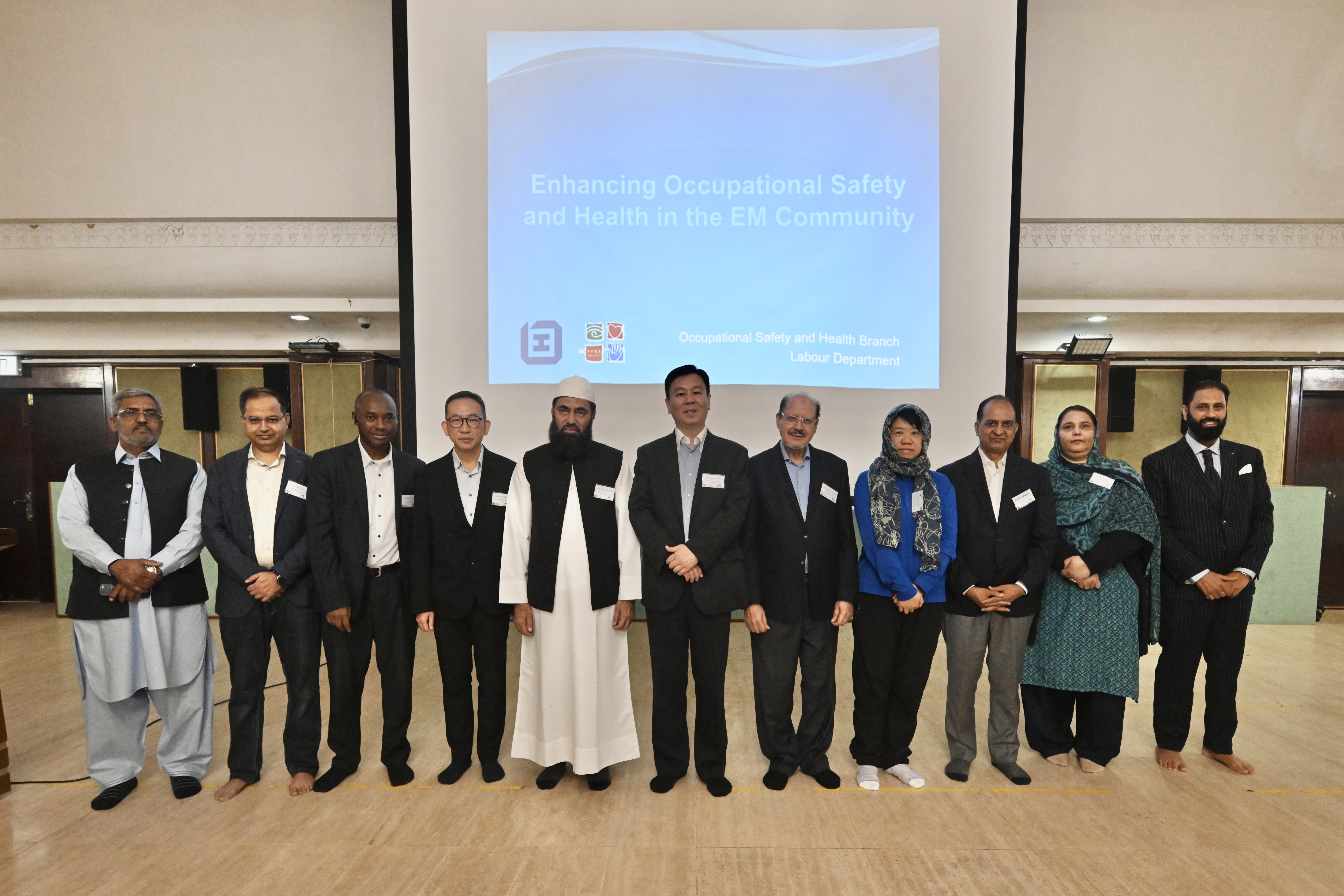
The Labour Department and the Occupational Safety and Health Council jointly held an occupational safety seminar at the Kowloon Masjid and Islamic Centre to enhance occupational safety awareness among ethnic minorities
4.29 In 2025, the LD employed a strategy of combining thematic publicity campaigns with enforcement actions to enhance awareness of the serious consequences of violations and raise the law-abidingness of those in charge. The thematic publicity activities including radio drama, banner advertisements on newspaper apps, banner on front page of LD’s website and OSH 2.0 app, and bus bodies. Certain campaigns also involved distributing relevant thematic banners to construction sites, displaying posters at Home Affairs Enquiry Centres, placing advertisements during Hong Kong Premier League matches, and screening promotional videos on the screens of external walls of buildings in prime districts.
4.30 In 2025, the LD, in collaboration with the OSHC, launched a two-year publicity campaign from 2024 to 2026 for heightening the publicity and promotion targeting new works and RMAA works. Through a wide range of initiatives, for examples, lunchtime on-site safety talks, seminars, sponsorship schemes, roving exhibitions, etc., we seek to reach different stakeholders of new works and RMAA works, including contractors and workers, in particular newcomers, workers of diverse races and property owners, to raise their work safety and health awareness.
4.31 Accidents in RMAA works have become a source of concern in recent years. With a view to reminding contractors and workers to pay extra attention to safety while carrying out truss-out scaffolding work and working at height, the LD, in collaboration with the OSHC and other relevant organisations, launched 10 safety seminars on RMAA works, truss-out scaffolding, bamboo scaffolding, electrical work, power-operated elevating work platforms and work-at-height safety in 2025. Other major publicity activities included broadcasting APIs on television/radio/mobile media, staging roving exhibitions, publishing feature articles in newspapers and on the LD’s website, publishing leaflets and disseminating safety messages to contractors, employers and employees through various means.
4.32 In March 2025, the LD published the latest revised version of Guidance Notes on Prevention of Trapping Hazard of Tail Lifts to provide more detailed explanations regarding the tripping devices. The compliance timetable for installation of tripping devices commenced on 1 June 2025 to facilitate the industry’s installation of tripping devices on their goods vehicles fitted with tail lifts in a smooth and orderly manner.
4.33 In 2025, the LD arranged for the rebroadcast of a five-episode promotional video series produced last year, effectively reinforcing OSH prevention awareness. The series covered key themes such as “Material Hoist”, “Power-operated Elevating Work Platforms”, “Truss-out Bamboo Scaffolds (Parts 1/2)” and “Application of Innovative Technologies for Construction Safety”, continuously delivering practical OSH information to the industry.
4.34 In respect of occupational health, the LD also collaborated with the OSHC and other relevant organisations, including the Occupational Deafness Compensation Board, the Pneumoconiosis Compensation Fund Board, employers’ associations, trade unions and community groups, in promoting occupational health as well as prevention of occupational diseases (e.g. occupational deafness and pneumoconiosis) and work-related diseases (e.g. musculoskeletal disorders, which are common among workers in service industry, clerical personnel and manual workers). This was achieved through a variety of activities such as organising occupational health awards, holding health talks and distributing promotional materials. In addition, we continued to run the “Heart Caring Campaign” jointly with the OSHC. Through health risk assessments, dissemination of healthy lifestyle information and various promotional activities, the Campaign encouraged employees in the property management and construction industries to develop healthy living habits with a view to preventing cardiovascular and cerebrovascular diseases. We also continued to co-organise the “Joyful@Healthy Workplace” programme and the “Mental Health Workplace Charter” with the Department of Health and the OSHC, and encouraged employers to participate in the programmes, in order to promote a health-friendly working environment and foster the physical and mental well-being of employees.
4.35 The LD continued to collaborate with the OSHC to launch a series of relevant publicity activities on heat stroke prevention. These included organising about 100 seminars with the OSHC and other organisations to help the industries apply the recommendations in the “Guidance Notes on Prevention of Heat Stroke at Work” to formulate appropriate heat stroke preventive measures. In addition, from May to October 2025, we co-organised a large-scale promotion campaign on heat stroke prevention again with the OSHC. Through distribution of heat stroke prevention items and extensive publicity, the campaign reminded employers and employees to prevent heat stroke at work. The “Cooling Products Sponsorship Scheme” was also relaunched, with subsidy items including cooling vests and solar-powered fans, giving employers and employees more options in the preventive measures against heat stress.
4.36 In 2025, the LD published 13 revised/new OSH publications and posters, including “Guidance Notes on Prevention of Trapping Hazard of Tail Lifts”, “Occupational Safety and Health Centre & Occupational Health Clinic”, “Safety Hints for Heavy Vehicles Tyre Demounting and Inflation Work”, “Safety Hints for Heavy Vehicles Tyre Demounting and Inflation Work” poster, “OSH Complaint Channels” poster, “Working at height Safety comes first” poster, “They Hold a Family's Fortunes” poster, “It Can Save a Life” poster, and “Prevent Truss-out Scaffold Accidents, Make Proper Use of Fall Protection Equipment” poster for promoting work safety and health.
4.37 Besides, we published three OSH publications in six languages (Indonesian, Hindi, Nepali, Tagalog, Thai and Urdu), namely “Occupational Safety and Health Centre & Occupational Health Clinic”, “An Employee's Guide to Work Involving Repetitive Movements or Manual Work” and “Guidance Notes on Fire Safety at Workplaces” and four OSH posters in three languages (Hindi, Nepali and Urdu), namely “Working at height Safety comes first”, “They Hold a Family's Fortunes”, “It Can Save a Life” and “Prevent Truss-out Scaffold Accidents, Make Proper Use of Fall Protection Equipment”, with a view to enhancing the safety awareness of workers of diverse races.
4.38 In 2025, the Occupational Safety and Health Branch handled 12 478 enquiries, advising on various safety and health matters. Furthermore, the Occupational Safety and Health Centre provides information and advisory services to employers and workers.
4.39 The LD collaborated with the property management sector to promote RMAA work safety and to step up the promotion of work-at-height safety to stakeholders, including contractors and workers, on the use of suitable working platforms instead of ladders for working above ground and the use of safety helmets with chin straps. We collaborated with the OSHC as well as the property management and construction industries to launch the “Promoting the Use of Light-duty Working Platforms Scheme Phase II”. Through property management companies, step platforms and hop-up platforms (light-duty working platforms) would be lent to contractors and workers conducting RMAA works in estates or residential buildings free of charge to encourage them to use light-duty working platforms for above-ground works instead of ladders. More than 600 eligible applications were received with about 1 600 light-duty working platforms provided.
4.40 Using straight ladders or A-ladders for work-at-height carries a lot of risk. In the past, there were several fatal accidents which involved workers falling from these ladders. In order to enhance the safety awareness of employers and workers in work-at-height, the LD collaborated with the OSHC to continue with the Enhanced Light-duty Working Platform Sponsorship Scheme for SMEs by subsidising small and medium enterprises (SMEs) to purchase enhanced step platforms and hop-up platforms for above-ground work. As at end of December 2025, 2 267 applications were received with 2 003 approved, benefiting over 33 000 workers. Regarding the Telescopic Scaffold Tower Sponsorship Scheme for SMEs which was launched in January 2024, as at end of December 2025, 711 applications were received with 446 approved, benefiting over 8 569 workers.
4.41 To enhance the safety of truss-out bamboo scaffolds (TOS) works, LD has been driving cross-sectoral collaboration among the scaffolding industry, the insurance industry, the CIC and the OSHC over the past year or so. This has facilitated the incorporation of the TOS industry into the designated trades under the CIC’s Registered Specialist Trade Contractors Scheme, and the co-ordination of the OSHC’s OSH Star Enterprise Schemes, so that the safety standards of TOS contractors can be accredited, and the premium of TOS work has been successfully reduced. This enables employers in the bamboo scaffolding industry to take out employees’ compensation insurance at relatively reasonable prices so as to form a virtuous cycle uplifting the overall safety standards of the industry.
4.42 The LD collaborated with the OSHC to ride on the HAD’s community platforms to promote RMAA work safety particularly work-at-height safety, to owners’ corporations, property owners and tenants, etc. In September 2025, the LD also collaborated with the OSHC and the HAD to organise two briefing sessions on RMAA works safety for District Council members and their office staff in 18 districts of Hong Kong, coordinating various parties to assist residents in dealing with safety issues encountered in RMAA works within the districts.
4.43 To promote safety awareness of the industry in operating boilers and pressure vessels, we distributed around 528 publications and leaflets regarding registration and safe operation of pressure equipment.
Application of Innovative Technologies
4.44 The LD actively promoted the use of innovative technologies by industries to improve OSH and provided advice on OSH legislation for technology products developed by industries, such as Remote-control Tower Crane Systems and Remote-control Systems for Excavators, to facilitate their introduction and application of such products, thereby reducing workers’ exposure to high-risk work and eliminating or controlling risks at source.
4.45 In addition, the LD also utilised appropriate technologies to enhance the enforcement effectiveness of frontline officers. Since October 2025, the LD has started using small unmanned aircraft to assist in inspections and law enforcement, which allows frontline officers to conduct aerial remote site surveillance and carry out inspections to remote or inaccessible workplaces to further curb unsafe work practices and generate three-dimensional photo-realistic models from images captured for assisting accident investigation.
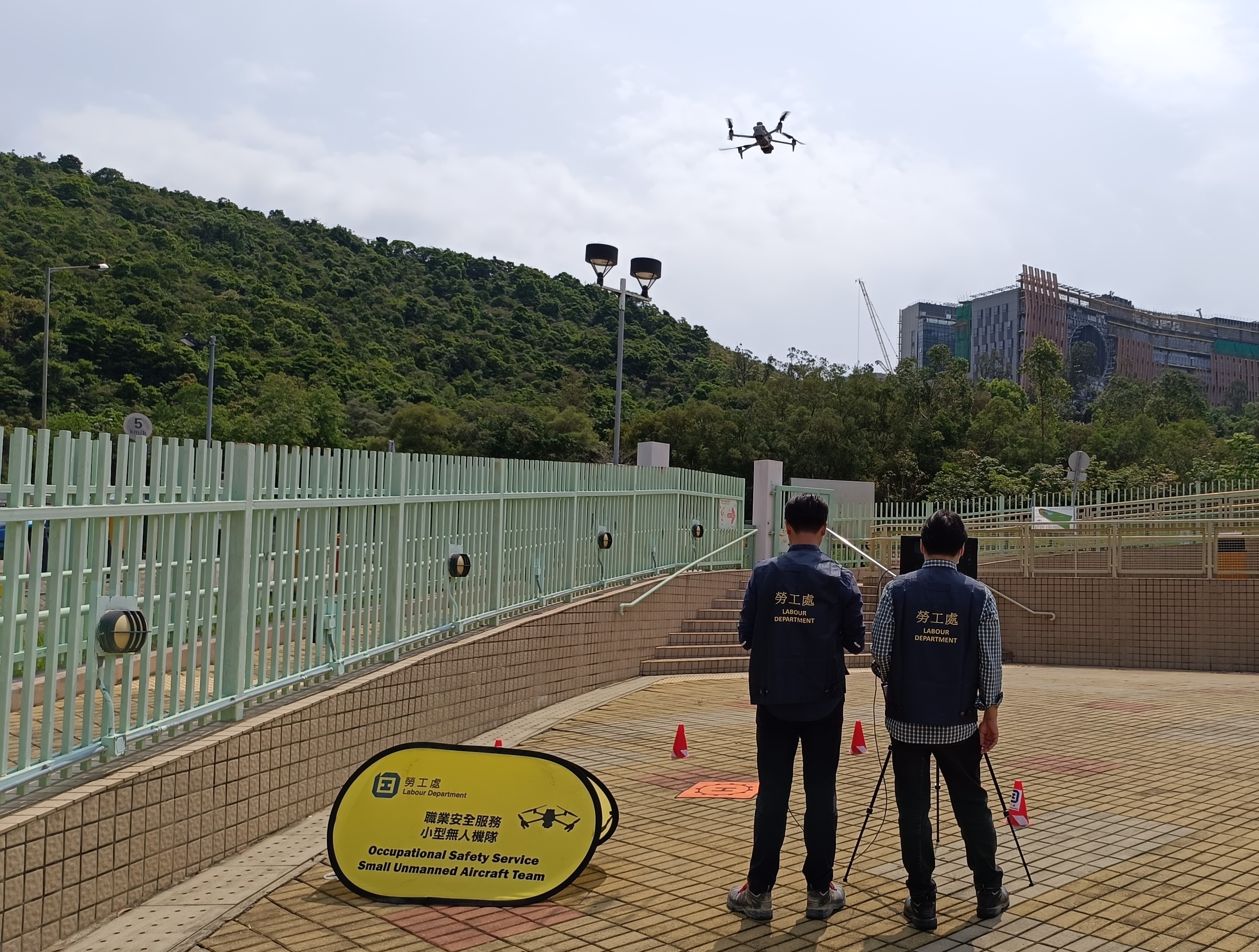
The Labour Department uses small unmanned aircraft to assist in inspections and law enforcement to combat unsafe work practices
Clinical Occupational Health Services
4.46 The LD runs occupational health clinics in Kwun Tong and Fanling, providing clinical consultations, medical treatment as well as occupational health education and counselling services for workers suffering from work-related and occupational diseases. Workplaces of the patients are inspected if necessary to identify and evaluate occupational health hazards in the work environment.
4.47 In 2025, 13 808 clinical consultations and 1 569 medical examinations were rendered. Moreover, patient support groups were organised to help patients achieve more desirable rehabilitation progress through health talks, experience sharing and peer support.