Skip to content

Annual Report 2003

Chapter 5
EmploymentServices

The Programme of Employment Services
(http://www.labour.gov.hk/eng/service/content.htm)
5.1

Unemployment remains the foremost concern of the Labour Department in 2003. To complement the job creation efforts of the Government, we give every assistance to local job-seekers, particularly the more vulnerable groups. The objective of the Employment Services Programme is to provide a comprehensive range of free and efficient employment assistance and counselling services to help job-seekers find suitable jobs and employers fill their vacancies. We achieve this by:

  • providing user-friendly employment services to employers and job-seekers;
  • offering intensive employment-related assistance and personal service to vulnerable groups of unemployed people;
  • assisting young people to enhance their employability and advising them on careers choice;
  • regulating local employment agencies;
  • safeguarding the interests of local employees employed by employers outside Hong Kong to work in other territories; and
  • ensuring that employment opportunities for local workers are not adversely affected by abuse of the labour importation scheme.
5.2

The two principal legislation administered by this programme area are the Employment Agency Regulations made under the Employment Ordinance and the Contracts for Employment Outside Hong Kong Ordinance.

5.3

The Employment Agency Regulations, together with the Part XII of the Employment Ordinance, regulate the operation of employment agencies in Hong Kong through a licensing system, inspection, investigation and prosecution.

5.4

The Contracts for Employment Outside Hong Kong Ordinance safeguards the interests of local manual workers and those non-manual employees with monthly wages not exceeding $20,000 who are recruited by employers outside Hong Kong to work in other territories through the attestation of employment contracts for these jobs.

Our Work and Achievements in 2003

Employment Situation in Hong Kong

5.5

The labour market remained generally slack in 2003. For data on labour force, unemployment rate and underemployment rate, please visit the following webpage: http://www.info.gov.hk/censtatd/eng/hkstat/fas/labour/ghs/labour1_index.html.

Key Indicators of Work

5.6

In spite of the difficult times, our untiring efforts and good performance have been widely recognised. Although unemployment rate remained at a high level, the department achieved a record high of 66 100 placements in the year. (Figures 5.1 and 5.2)

A Wider Service Choice

Services offered at Job Centres

5.7

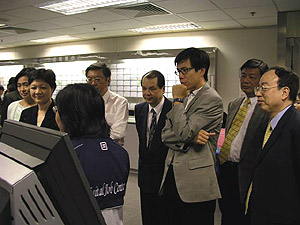
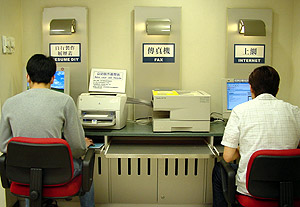
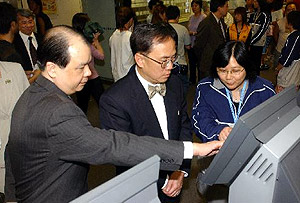
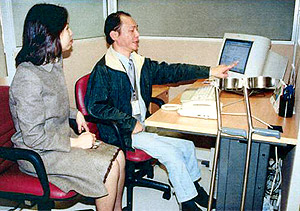
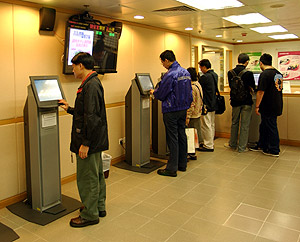
Job-seekers can select suitable vacancies and seek referral service at all job centres. Modern facilities such as digital display system, self-service touch-screen vacancy search terminals, fax machines, toll-free telephones, computers connected to the Internet and a careers information corner are available.

5.8

Through the Job Matching Programme, placement officers will help job-seekers evaluate their academic qualifications, job skills, work experience and job preferences, and encourage them to look for suitable jobs actively. Placement officers will also introduce suitable retraining courses to job-seekers where appropriate.

Telephone Employment Service

5.9

Registered job-seekers may call our Telephone Employment Service Centre at 2969 0888 for job referral service. Through conference calls, staff of the centre can make arrangement for job-seekers to talk to employers directly.

Internet Employment Service

5.10

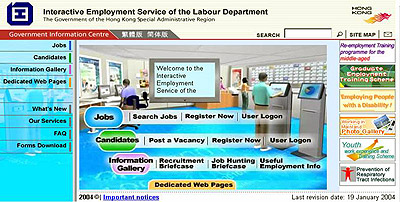
Our Interactive Employment Service (iES) website (http://www.jobs.gov.hk) provides round-the-clock Internet employment service. The iES is one of the most popular government websites in Hong Kong, accounting for about one-third of the page views for all government websites. In 2003, the iES achieved a record number of 621 million page views, a significant increase of 216 per cent over 2002. It hyperlinks with nine leading employment websites in Hong Kong and hosts a number of dedicated webpages for specific clientele groups. The website was redesigned in 2003 to provide better navigation for members of the public. Also, the webpage on information on employment in the Mainland was revamped in the year to provide more comprehensive information to job-seekers.

Central Processing of Job Vacancies

5.11

Employers who need to recruit staff can send their vacancy information to our Job Vacancy Processing Centre by fax (2566 3331) or telephone (2503 3377) or Internet (http://www.jobs.gov.hk). Vacancy information will be posted at all job centres and uploaded onto the iES through computer network in one working day.

Special Recruitment Functions and Promotional Activities

5.12

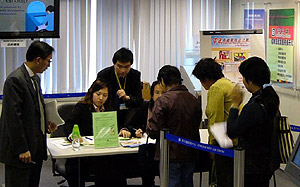
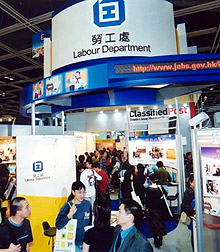
We organise a variety of activities to promote our employment services. Visits and briefings are conducted to appeal for vacancies from employers. Recruitment seminars and job fairs are held to facilitate job-seekers and employers to meet and communicate directly. In 2003, these special recruitment and promotional activities included territory-wide large-scale job fairs as well as thematic functions such as "Recruitment Forum for Property Management" and "Recruitment for the Re-employment Training Programme for the Middle-aged". These activities reached out to about 77 500 job-seekers and employers.

Intensified Services to the Most Needy

Serving the Middle-aged Job-seekers

5.13

The Re-employment Training Programme for the Middle-aged was launched in May 2003 to provide intensive employment service to job-seekers aged 40 or above who had been unemployed for three months. Employers who engage a participant of the programme in full-time permanent posts and offer him on-the-job training will receive a training allowance of $1,500 per month, for up to three months. During the year, 2 048 placements were achieved through the programme.

Serving Local Domestic Helpers

5.14

In 2003, we continued to publicise our dedicated employment services for local domestic helpers. Through the website of the iES, roving exhibitions, job fairs and many other promotional efforts, the service was widely introduced in different parts of the territory.

Serving New Arrivals

5.15

Through our 11 job centres, including the two Employment and Guidance Centres for New Arrivals in Shau Kei Wan and Mong Kok, we provide a comprehensive range of employment service to new arrivals.

Serving Workers affected by Large-scale Retrenchment

5.16

We assign special counters at the job centres or render on-the-spot employment services to workers affected by major retrenchments. In 2003, the service reached out to 2 715 retrenched workers of 21 companies.

Serving the University Graduates of 2003

5.17

The Graduate Employment Training Scheme was launched on 1 August 2003 in conjunction with seven local universities to place fresh graduates into training posts under the scheme. Employers providing on-the-job training for these graduates received a training subsidy of $2,000 for six months. Up to 31 December 2003, more than 1 100 graduates had been placed under the scheme.

Serving Job-seekers with a Disability

5.18

The Selective Placement Division (SPD) provides personalised counselling, employment services and referrals to tailor-made retraining programmes to job-seekers with a disability who seek open employment. In 2003, SPD registered a record number of 4 309 disabled job-seekers and succeeded in placing 2 442 of them in employment. The placement rate was 57 per cent. (Figure 5.3)

Trial Placement-cum-Mentor Scheme

5.19

The Trial Placement-cum-Mentor Scheme for People with a Disability was launched in January 2002. It aims at motivating employers to recognise the working abilities of people with a disability through a one-month trial placement, thereby enhancing the employment opportunities of people with a disability. Participating employers will receive a subsidy equal to half of the wages paid in the one-month trial period, subject to a ceiling of $3,000. A mentorship element has been included in the scheme to help the disabled workers on trial to settle in the jobs more easily. The response from employers has been encouraging. By the end of 2003, there were 282 employers offering 527 job vacancies. About 82 per cent of the 466 disabled persons participating in the scheme were offered full employment by their employers after the trial period.

Self Help Integrated Placement Service

5.20

The Self Help Integrated Placement Service (SHIPS) aims at improving the job-searching skills of disabled job-seekers and encouraging them to be more proactive in the search for jobs, thereby enhancing their employment opportunities. In 2003, 725 disabled job-seekers participated in the programme. The overall placement rate was about 55 per cent.

Interactive Selective Placement Service (iSPS) Website

5.21

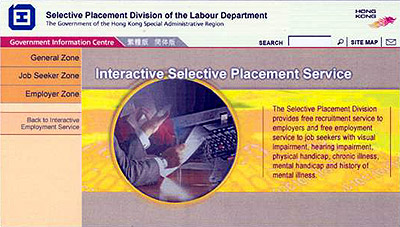
The Selective Placement Division (SPD) launched an Interactive Selective Placement Service (iSPS) Website (http://www.jobs.gov.hk/isps) in January 2003 to provide improved employment services for disabled job-seekers and employers through the Internet. The website enables (a) disabled persons to register, for the first time, for SPD's placement service or renew their previous registrations with SPD, browse the vacancies available and perform preliminary job-matching, and (b) employers to place vacancy orders with SPD, identify suitable disabled job-seekers to fill their vacancies, or request SPD to refer candidates to them for selection interview. Response to the iSPS has been very favourable. Up to the end of 2003, it had recorded a total of 3 842 942 page views and 5 806 online requests for SPD's services.

Promotional Activities

5.22

A series of radio programmes was produced during the year to enhance public understanding of the working abilities of people with a disability. We also held seminars for employers and conducted special promotional campaigns on targeted trades to canvass vacancies from employers.

Services for Young People

Youth Work Experience and Training Scheme (YWETS)

5.23

The YWETS features 50 hours of guidance and counselling services to trainees by case managers who are registered social workers; 40 hours of induction training on communication and interpersonal skills for trainees; training subsidy payable to employers at the rate of $2,000 per trainee per month during the period of on-the-job training; and training allowance of $4,000 payable to trainees who undertake vocational training courses on an off-the-job basis.

5.24

The Labour Department actively canvasses training vacancies from both the private and public sectors. In addition, it tailor-makes special employment projects for different trades and occupations to provide diversified training opportunities for trainees under the YWETS. They include a special project to introduce to trainees employment opportunities on the Mainland, and the "Action S4" project catering specifically for the needs of the more vulnerable trainees.

5.25

The target of the YWETS is to provide 10 000 training places for young people by July 2004. This was achieved in November 2003, eight months ahead of schedule. As at the end of December 2003, 10 971 trainees were successfully placed in training vacancies under the scheme. In addition, 7 632 trainees were placed in other jobs in the open employment market with the advice and assistance of their case managers.

5.26

Feedback from trainees, employers and case managers on the YWETS are highly favourable. Independent consultants from the Centre for Social Policy Studies of the Hong Kong Polytechnic University also confirmed the effectiveness of the scheme in enhancing the employability of young people in a mid-term review conducted in 2003.

Youth Pre-employment Training Programme (YPTP)

5.27

In 2003, we continued with the YPTP and provided a wide range of employment-related training and workplace attachment opportunities. Government departments, training bodies and voluntary agencies join hands to provide the following four modular training: (a) leadership, discipline and team building; (b) job-search and interpersonal skills; (c) elementary/ intermediate computer application; and (d) job-specific skills training. Organisations from the private and public sectors as well as social welfare agencies offer workplace attachment training places for trainees to obtain practical work experience and better understand the world of work. Professional youth workers are available to provide career counselling and support services throughout the programme. In the new phase of the programme, the training capacity was expanded from 12 000 to 18 000 to benefit more young people in response to the impact of SARS. A number of training courses geared to market needs were added. Workplace English or Putonghua was included in the training to enhance trainees' language ability.

Careers Information and Guidance

5.28

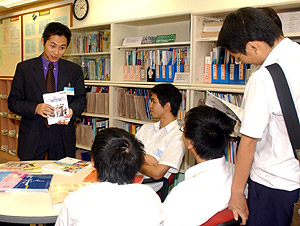
We operate two careers information centres that function as information banks for young people and careers teachers. Each centre has a reference library with publications and audio-visual resources on employment and training opportunities. Careers videos and VCDs are available for free loan to secondary schools and youth organisations. Careers counselling and guidance service are also available to visitors of the centre. In 2003, we received 44 304 visitors and handled 41 944 consultations.

5.29

To provide young people with first-hand careers information, we organised a variety of careers activities in 2003, with 972 475 participants recorded.

5.30

We jointly organised the Education and Careers Expo with the Hong Kong Trade Development Council for the 13th time in 2003 to provide the latest information on careers development and further education options. There were 366 participating exhibitors from a wide range of trades, government departments and professional bodies, as well as local and overseas educational and training institutes. The event attracted 184 359 visitors and proved to be the most popular careers information event in Hong Kong.

5.31

In collaboration with the Education and Manpower Bureau, we organised a comprehensive service package for Form 5 school leavers to provide them with a full range of counselling and information on careers and further education opportunities. An Information Expo in August attracted over 10 000 visitors. Hotlines, chat room service and advisory centres were set up and served about 2 900 students and their parents. More than 90 000 copies of the tailor-made careers handbook were distributed.

5.32

Two part-time certificate courses were organised for in-service careers masters in the 2003/2004 school year in collaboration with the Education and Manpower Bureau.

Regulating Local Employment Agencies and Employment Outside Hong Kong

5.33

We monitor the operation of employment agencies through licensing, inspection and investigation of complaints. In 2003, 1 393 employment agency licences were issued. Four licences were revoked, one application for renewal of licence and two applications for issue of licence refused. A total of 1 364 enforcement inspections was made to employment agencies. At the end of 2003, there were 1 330 licensed employment agencies in Hong Kong.

5.34

We regulate employment outside the territory to safeguard the interests of local employees engaged by employers outside to work in other territories by attesting all employment contracts entered in Hong Kong involving manual employees and non-manual employees with monthly wages not exceeding $20,000.

Regulating Labour Importation

5.35

To cater for the genuine needs of employers, a Supplementary Labour Scheme that allows the entry of imported workers to take up jobs at the technician level or below and which cannot be filled locally, is administered by the Labour Department. It operates on the principles of ensuring the priority of local workers in employment while allowing employers with proven local recruitment difficulties to import labour to fill the necessary job vacancies. As at the end of 2003, there were 936 imported workers in Hong Kong.

5.36

We provide active job matching and referral services to local job-seekers to ensure their employment priority. Vacancies under the scheme are widely publicised locally. To facilitate local workers in filling the vacancies, they could attend tailor-made retraining courses, if appropriate. Applications from employers who have set restrictive or unreasonable requirements in terms of age, education, sex, skill or experience for the vacancies or who have no genuine intention to employ local workers will be rejected.