Labour Department
Chapter 4
Safety and Health at Work
The Programme of Safety and Health at Work4.1 The Occupational Safety
and Health Branch of the Labour Department is responsible
for the promotion and regulation of safety and health
at work. The objective of the Programme of Safety and
Health at Work is to ensure that risks to people's safety
and health at work are properly managed and reduced
to the minimum by legislation, education and promotion.
More specifically, we achieve the objective by:
4.2 The principal legislation
for safety and health at work includes the OSHO, the
FIUO, and the BPVO.
4.3 With few exceptions,
the OSHO protects employees' safety and health at work
in practically all branches of economic activities.
It is basically an enabling legislation that empowers
the Commissioner for Labour to make regulations prescribing
standards for general working environment as well as
specific safety and health aspects at work. The Occupational
Safety and Health Regulation made under the OSHO sets
down some basic requirements for accident prevention,
fire precaution, workplace environment and hygiene,
first aid and manual handling operations.
4.4 The FIUO regulates
safety and health at work in industrial undertakings,
which include factories, construction sites, cargo and
container handling areas, as well as catering establishments.
4.5 The BPVO aims at regulating
the standards and operation of equipment such as boilers,
pressure vessels, including thermal oil heaters, steam
receivers, steam containers, air receivers and pressurised
cement tanks mounted on trucks or trailers.
Our Work and Achievements in 2002Continuous Improvement in Safety Performance 4.6 Hong Kong's occupational
safety and health performance continued to improve in 2002,
with notable improvement in the construction industry.
4.7 A total of 47 023
occupational injuries (Note 2), including 210 fatal
cases, occurred in 2002, representing a drop of 12.5
per cent when compared to the figures of 2001. Among
these occupational injuries, there were 22 453 industrial
accidents, decreased by 21.3 per cent in comparison
with that of 2001. In particular, the accident figure
for the construction industry has dropped significantly
by 32.2 per cent.Figures 4.1~4.5
Note 2: Occupational injuries (both industrial and non-industrial) are those injuries arising from work accidents, resulting in death or incapacity for work of over three consecutive days, and reported under the Employees' Compensation Ordinance.
Key Indicators of Work 4.8 Some key indicators
of work of this programme area are shown in Figure
4.6.
Legislative Improvements 4.9 In 2002, we amended
the Factories and Industrial Undertakings (Woodworking
Machinery) Regulations to prohibit the employment of
persons under 16 years of age working on any woodworking
machine with a view to complying with the International
Labour Convention No. 182: The Worst Forms of Child
Labour Convention, 1999. We also extended the Factories
and Industrial Undertakings (Safety Officers and Safety
Supervisors) Regulations to cover the container handling
industry and revised provisions regarding the qualifications,
duties and revalidation of Registered Safety Officers.
We brought into operation the provision to implement
a safety management system in specified industrial undertakings
and the requirements on training and certification of
operators of certain loadshifting machines. In April
2002, the Occupational Safety and Health (Display Screen
Equipment) Regulation was enacted to protect the safety
and health of employees who use display screen equipment
for prolonged period of time.
Law Enforcement 4.10 To secure safety and health at work, we inspect workplaces, monitor health hazards, investigate work accidents and occupational diseases, register and inspect boilers and pressure equipment and advise on measures to control hazards or prevent recurrences.
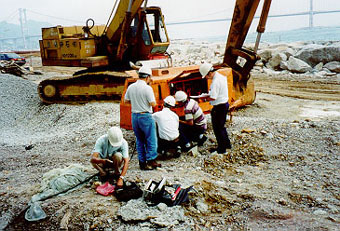
4.11 A key element in enforcement is to advise on prevention of accidents. We conducted special promotional visits to encourage employers to adopt a self-regulatory approach in managing risk at the workplace. A number of special blitz operations and campaigns were also organised on the safety of work at height, scaffold, container handling, gas welding and flame cutting, fire and chemical, and plant and machinery.
4.12 We continued to target
at establishments with poor safety performance for close
surveillance. Improvement notices or suspension notices
are issued to secure a speedy rectification of irregularities,
or to remove imminent risk to lives and limbs. Many
of these companies, especially those in the construction
industry, have shown significant improvements in their
safety performance. In view of the public concern about
the health and safety of cleansing workers employed
by government contractors, a special campaign was mounted
to step up the inspection of cleansing work in government
properties in order to ensure compliance with relevant
legislative requirements.
4.13 The Commissioner for Labour, as the Boilers and Pressure Vessels Authority, recognises competent inspection bodies to assess and inspect new pressure equipment during manufacturing. As at the end of 2002, there was a total of 33 appointed examiners and six recognised inspection bodies. We also conduct examinations, monitor courses for training of competent persons and issue certificates of competency to qualified candidates as competent persons for various types of boilers and steam receivers. In 2002, 740 candidates were examined, of whom 603 were awarded certificates of competency. We also advise the Fire Services Department on approval and preliminary inspections of pressurised cylinders and storage installations for compressed gas.
4.14 As at 31 December 2002,
a total of 149 798 workplaces, including 12 620 construction
sites, were recorded. In 2002, 131 419 inspections were conducted
under the OSHO and the FIUO, while 6 444 inspections were
made under the BPVO. 37 544 warnings were issued by Occupational
Safety Officers while 4 389 warnings were given under the
BPVO. Altogether, 2 045 suspension or improvement notices
were issued. We also carried out 12 821 accident investigations
and investigated 3 336 suspected occupational diseases in
the year. Among the suspected occupational diseases, 364 cases
were confirmed. Figures
4.7~4.9
Safety Training and Occupational Health Education 4.15 We provide training-related services to help industry reduce occupational injuries. Such services are divided into three broad categories, namely training courses, accreditation of external training providers and registration of safety officers and safety auditors.
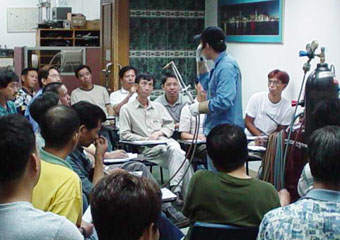
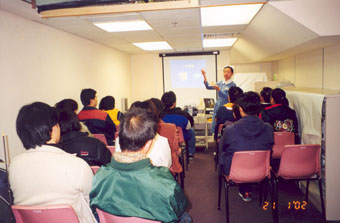
4.16 In 2002, we conducted 565 training courses on safety legislation for 4 782 participants and 241 tailor-made safety briefing sessions for 8 550 employees. We also accredited 21 mandatory basic safety training courses for the construction and the container-handling industries. As at the end of 2002, more than 548 000 persons have completed the training. We also accredited 13 confined spaces safety training courses, 12 loadshifting machinery safety training courses and 16 gas welding and flame cutting safety training courses.
4.17 In 2002, 178 applicants
were registered as safety officers while 145 applicants were
registered as safety auditors. As at the end of 2002, there
were 2 425 persons on the register of safety
officers and 490 persons on the register of safty auditors.
4.18 Occupational health
education is an important strategy for the control of
occupational health hazards and prevention of occupational
diseases. Apart from the conventional way of organising
health talks at our own premises, we have also developed
outreaching services for occupational health education
by delivering talks at individual companies or organisations.
In 2002, we delivered 2 372 health talks.
Safety Promotion 4.19 To inculcate a safety
culture and to enhance safety awareness, we organised
various promotional activities in 2002, some in conjunction
with the Occupational Safety and Health Council, trade
associations, workers' unions and other government departments.
4.20 Under the Customer
Service Teams Project, volunteers made 14 000 visits
to small and medium-sized enterprises to introduce the
OSHO and promote safety management concepts.
4.21 The well-received Catering
Industry Safety Award Scheme and the Construction Industry
Safety Award Scheme were organised again in the year. Campaigns
were also launched to promote and publicise the Factories
and Industrial Undertakings (Safety Management) Regulation,
the Factories and Industrial Undertakings (Loadshifting Machinery)
Regulation, the Factories and Industrial Undertakings (Gas
Welding and Flame Cutting) Regulation and the safety of working
at height.
4.22 The Occupational
Safety Charter was jointly launched with the Occupational
Safety and Health Council in 1996 to promote the spirit
of 'shared responsibility' among employers and employees
in workplace safety and health. It sets out a safety
management framework for employers and employees to
work together to create a safe and healthy working environment.
By the end of 2002, 674 organisations, including public
utilities companies, industrial and non-industrial establishments,
construction companies, unions and associations, have
subscribed to the Occupational Safety Charter.
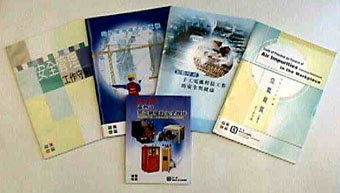
Publicity and Advisory Service 4.23 In 2002, 24 new occupational
safety and health publications were published, including
five codes of practice that provide practical guidance
respectively on safety management, control of air impurities
from chemical substances, safe use of tower cranes,
safe operation of electric steam boilers and safety
on manual electric arc welding. Some of the new publications
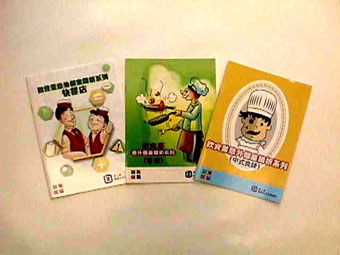
are listed in Figure 4.10.
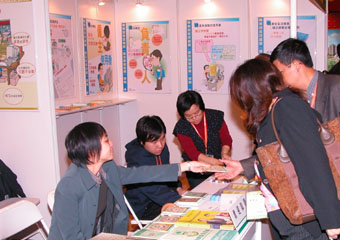
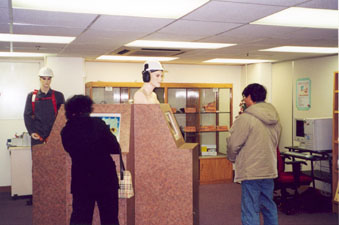
4.24 In 2002, we handled 32 377 enquiries, advising on various occupational safety and health matters. One-stop information and advisory services are provided to workers and employers at the Occupational Safety and Health Centre.
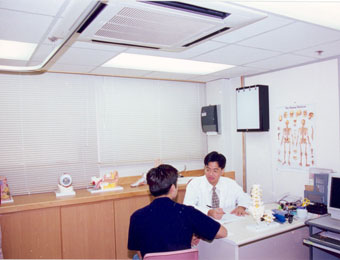
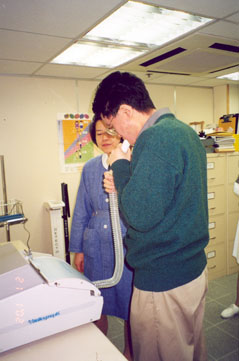
Medical and Clinical Services 4.25 Our medical and nursing staff at the Kwun Tong and Sham Shui Po Occupational Health Clinics provide clinical consultations, medical treatment as well as occupational health education and counselling services for workers suffering from work-related diseases. The workplaces of the patients are inspected if necessary to identify and evaluate occupational health hazards in the work environment. We also assess the medical fitness for work of radiation workers, aviation personnel and government employees exposed to specific occupational health hazards.
4.26 In 2002, 9 679 clinical consultations were rendered, and 2 463 medical examinations and assessments performed. Ten patient support groups were organised to promote patients' treatment compliance and sustainability in good work practices through health talks, experience sharing and peer support.Figure 4.11.
Improved Application of Information Technology 4.27 In 2002, we have
improved our electronic databank that contained information
on occupational accidents, safety and health legislation,
legal advice and reference materials. We are also developing
an Occupational Safety and Health Management Information
System to facilitate communication and information sharing
in the Headquarters and regional offices.
|