Speech by the Commissioner for Labour, Mr Matthew Cheung Kin-chung, at the Australian and New Zealand Asssociation of Occupational Health and Safety Educators 2000 Conference
Following is an opening address by the Commissioner for Labour, Mr Matthew
Cheung Kin-chung, on "Hong Kong's Occupational Safety and Health in the
New Millennium" at the Australian and New Zealand Association of Occupational
Health and Safety Educators (ANZAOHSE) 2000 Conference
on Wednesday, January 19, 2000:
Introduction
Welcome to Hong Kong and welcome to the new millennium.
Thank you for inviting me to officiate at this opening ceremony. It is a pleasure to meet so many overseas and local occupational safety and health professionals at this international event and I am indeed honoured to deliver this opening address.
I first became aware of the Australian and New Zealand Association of Occupational Health and Safety Educators when the organisers of your previous conference in Auckland invited a representative from this Department to attend and present a paper at the conference. I took particular interest in the objectives of your Association and all that you have achieved, in such a relatively short time since your formation. As a result, we have not only accepted the invitation to attend and deliver a paper at the Auckland event but also accepted the challenge to host the next conference in Hong Kong. I am confident that the extension of your Association's horizon to this part of the Asian Pacific region will result in enormous benefits to the OSH profession in the entire region.
I have organised my presentation into three major parts. I want to kick off by giving you a bit of the economic and social context in which the Hong Kong Occupational Safety Officers, formerly known as Factory Inspectors, operate. Then I want to paint a broad picture of how Hong Kong is performing in relation to occupational safety and health. In line with your conference theme, I will finish by discussing the education and training strategies we have adopted to support occupational safety and health in Hong Kong.
Hong Kong's economy and social context
Hong Kong has a population of 6.8 million and a workforce of about 3.4 million. Hong Kong occupies a total area of just over 1,000 square kilometres and hence a population density of over 6,000 persons per square kilometre. Amazingly, by comparison, Queensland enjoys a population density of three persons per square kilometre. It is sometimes hard for foreigners to imagine the living conditions of the people of Hong Kong and their energy-charged lifestyles.
Hong Kong is well known for its completely open market, free competition and entrepreneurship. This is a world-class city with excellent services and communications support. Be that as it may, Hong Kong is not insulated from economic ups and downs in the global scene. Like our neighbouring economies, we were affected by the fall-out of the Asian financial turmoil last year and are still undergoing a painful economic adjustment.
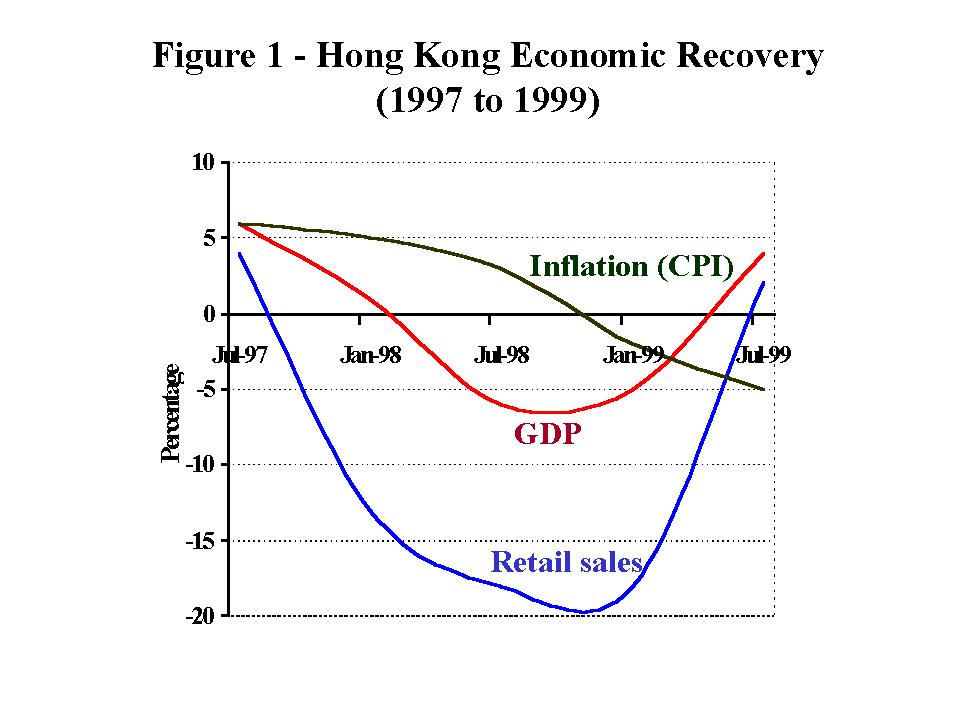
Fortunately, these are clear signs that Hong Kong's economy is gradually
recovering. The economy grew by 4.5 % in the third quarter of last
year,
exceeding market expectations. We are enjoying a "V" curve recovery,
after bottoming out at the beginning of last year. This prompted
the Government to dramatically revise the full-year's estimated growth
of gross domestic product (GDP) from a meagre 0.5 % to 1.8 %. The
principal driving force for the strong recovery was the increase in exports
and consumer spending.
|
To enlarge the picture, please click it
|
 |
Unfortunately, unemployment is stubbornly high, at 6 percent. Salary levels in Hong Kong are high compared to some of our competitors. Despite pressures of downsizing and wage adjustment, the median household income in the third quarter of this year stood at the equivalent of AUD $41,600 or NZ $52,300 per annum.
The Hong Kong Special Administrative Region Government is keen to strengthen the foundation of the economic recovery. Over the next five years, the Government will expand its infrastructure by investing heavily. Over AUD $50.8 billion or NZ$64 billion will be spent on Hong Kong's railway system, public housing programs, a new cyberport, a science park and in the expansion of port and container handling facilities. China's impending entry to the World Trade Organisation (WTO) should provide further opportunities for overseas trading through Hong Kong. Recently, Hong Kong was also chosen as the site for the fifth Disneyland. As a result of these major development plans, the construction workforce is expected to rise from 72,000 in December 1998 to 115,000 by 2003.
On the whole, though, Hong Kong is undergoing a major economic adjustment and a redistribution of its 3.4 million workforce. The traditional manufacturing and industrial sectors are on the decline. The employment size of these sectors was reduced from 534,000 workers in 1995 to 391,000 workers in 1998, a drop of 27%. This decline is mainly caused by the steady relocation of a significant proportion of production factories to Mainland China where land, labour and other costs are much lower than those of Hong Kong.
Offsetting this decline is a significant growth in the non-industrial sector, particularly in the service and communications trades. The employment size in these sectors has grown from 2,100,000 to 2,364,000 workers over the same period.
Occupational safety and health in Hong Kong
The structural changes which I highlighted earlier have made an impact on the way workplace safety and health is being managed here in Hong Kong. Let us first take a quick glance at the occupational safety performance in Hong Kong.
Overall OSH performance in Hong Kong
Based on the Census and Statistics Department records, the accident rate for the industrial sector was 64.7 per thousand workers in 1998. For the non-industrial sector, the rate was 12.0 per thousand workers in 1998. I want to do a more detailed analysis of our OSH performance to help you understand the situation better.
OSH performance by industry
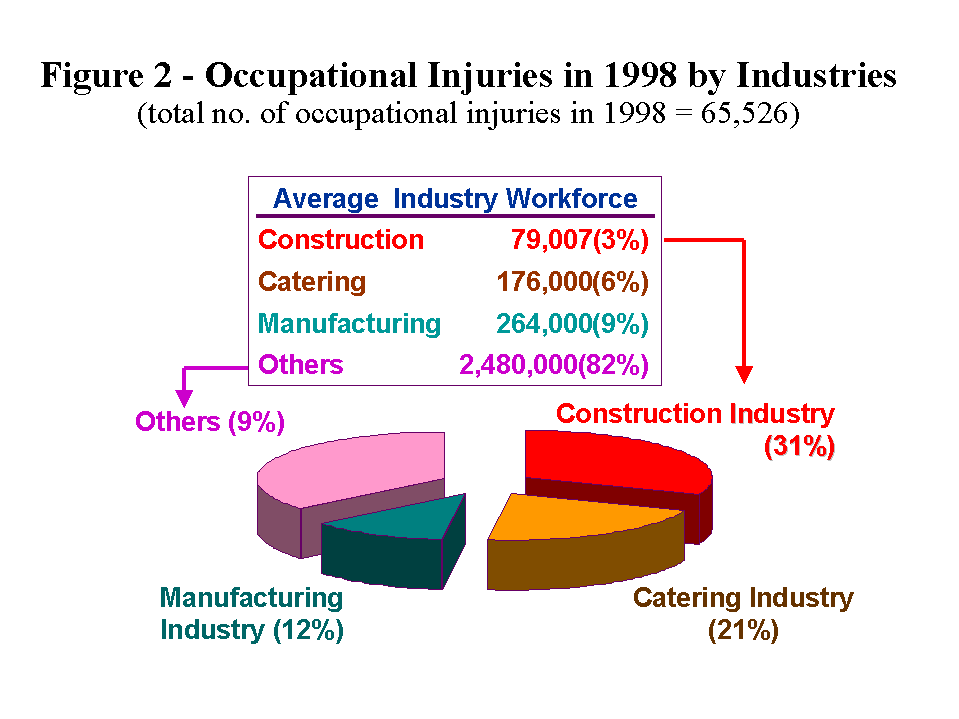
As in most other countries, certain industries in Hong Kong are significantly more hazardous by the nature of their activities. Not surprisingly, the construction industry has always topped the league table. Figure 2 shows the industry breakdown of the 63,526 occupational injuries that were recorded in Hong Kong during 1998. Such injuries include those that resulted in death or being away from work for three or more consecutive days. About 31% of such injuries were related to the construction industry, which only employed about 3% of Hong Kong workforce. By comparison, 9% of such injuries occurred in the manufacturing industry, which employed 12% of the workforce.
|
To enlarge the picture , please click it
|
 |
I am pleased to say that Hong Kong's performance in occupational safety and health has been improving over the last couple of years. Comparing the accident rates between the first half years of 1998 and 1999, there is obviously a downward trend. Figure 3 shows the number of accidents in the two periods and, by comparison, there is a drop of over 4,000 accidents or a reduction of 19%. This is rather encouraging.
|
To enlarge the picture, please click it
|
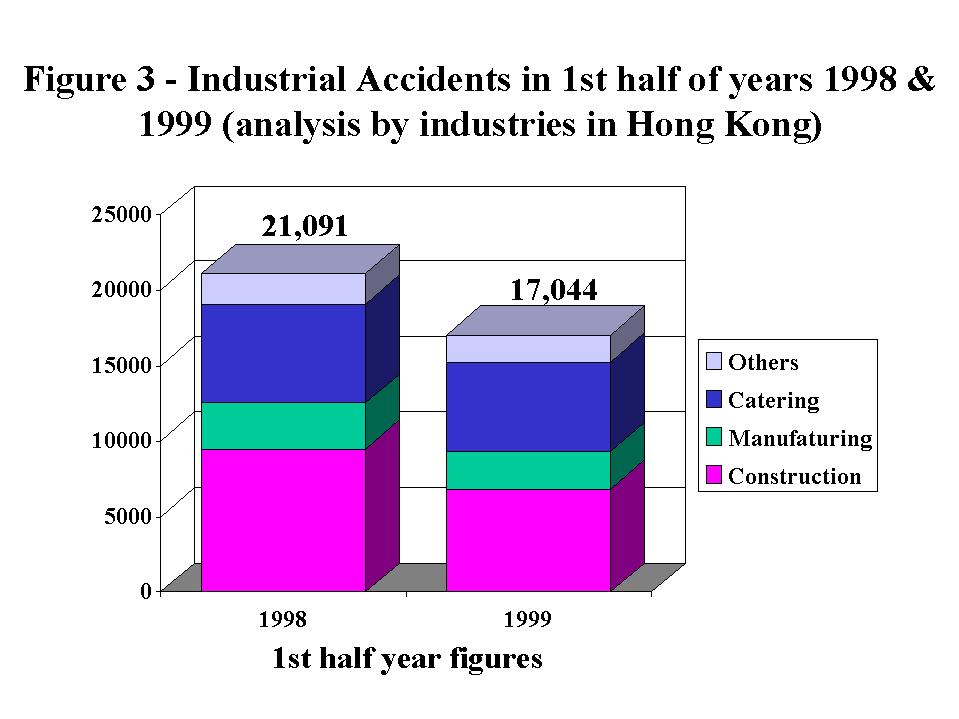 |
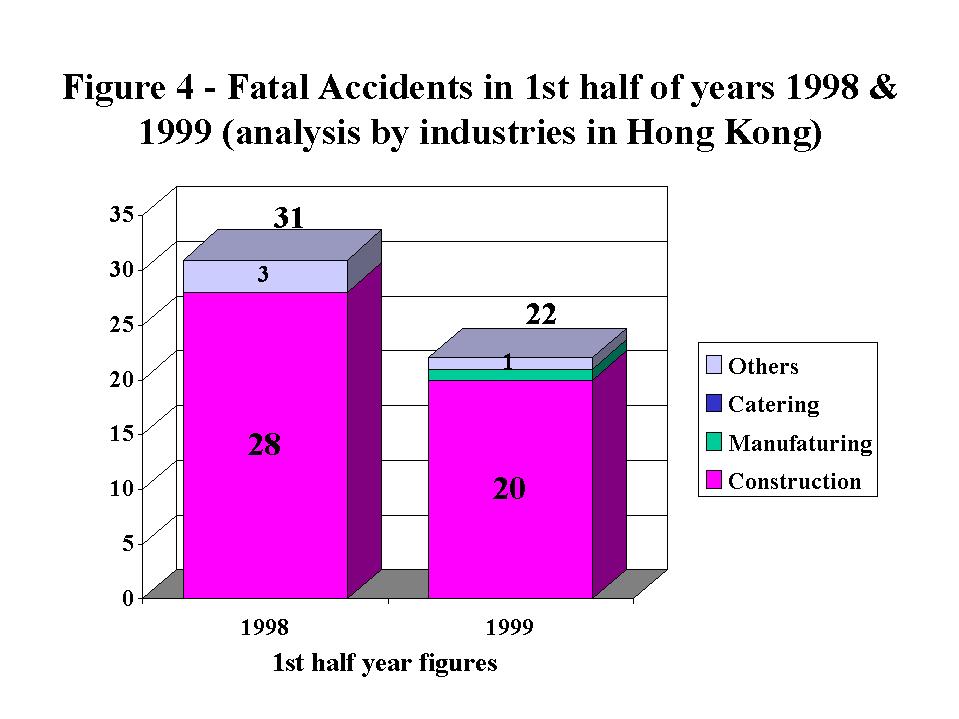
Figure 4 shows the fatal accident rates for the same periods. By comparison there is also a slight drop in numbers during the first half of 1999, compared to the corresponding period in 1998. Despite the downward trend, the number of fatal accidents in the construction industry is still unacceptably high. My department will continue to concentrate our effort on that industry. With so many fatal accidents in the construction industry, it is no wonder that we have the sad saying amongst OSH professionals that, “You join the navy to see the world and join the construction industry to see the next!”
|
To enlarge the picture, please click it
|
 |
So even though the overall accident trend appears to be improving, my department is certainly not slowing down our efforts in promoting OSH in Hong Kong. If anything, we will continue to step up our efforts in order to bring the accident toll to a minimum.
OSH Legal Framework
In Hong Kong, the legal framework for ensuring the safety and health of workers is provided under two sets of legislation. First, there is the Factories and Industrial Undertakings Ordinance, which is a prescription-based legislation that provides OSH coverage to industrial workplaces including factories and construction sites. Then there is the more recent performance-based Occupational Safety and Health Ordinance, which covers all industries in Hong Kong. Even though there is a mixture of two types of legislation at present, the longer-term objective is to move away from the prescriptive approach and go for performance-based approach in keeping with international trends.
Human resources to administer the OSH legislation
Some of the human resource problems confronted by the Hong Kong Labour Department, such as scarce manpower resources, inadequate support from specialist OSH disciplines and insufficient information technology (IT) support, are probably "universal" with OSH authorities around the world. In a bid to address these problems, we created a new Occupational Safety and Health Branch within the Labour Department in 1996 under a new deputy commissioner. He was charged specifically with the responsibility of implementing a "culture change" in our community as well as among the professional officers under his command.
Over the past three years, my Department has undergone an enormous amount of change. Our services to clients are more customer-oriented. Our enforcement action is more focused and vigorous. Our staff members are receiving more effective training and support. Our international contacts are much broader as witnessed by your presence here in Hong Kong. Most important of all, employers and employees are beginning to get the message that we will not accept half-hearted efforts or lip service.
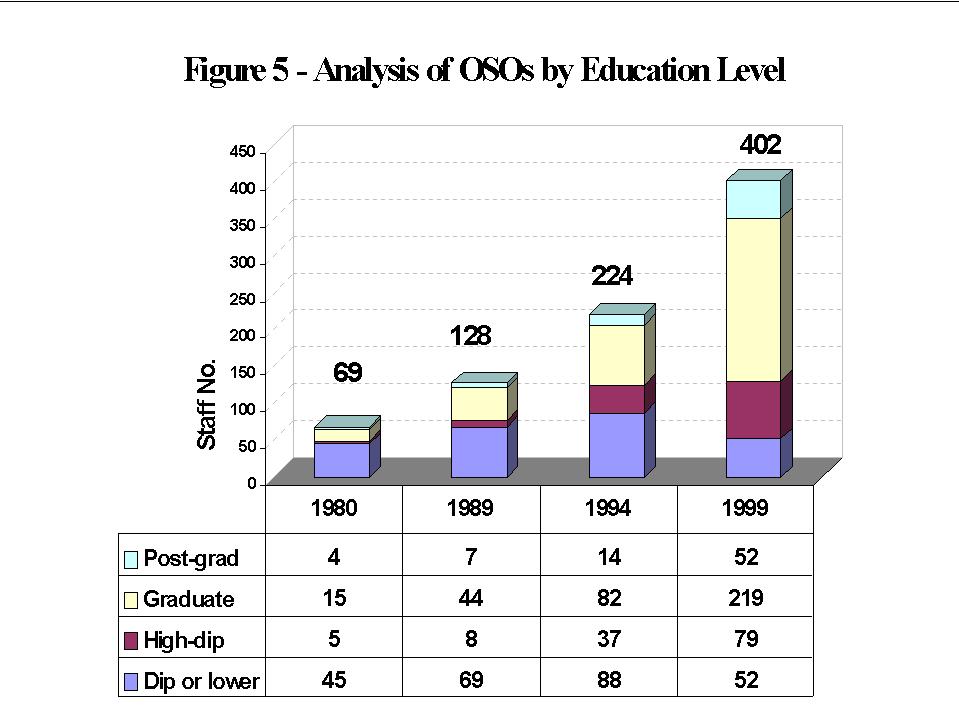
Meanwhile, the education level of my department's occupational safety officers (OSOs, who were formerly known as Factory Inspectors (FIs)) has been rising steadily. Figure 5 is very telling. Not only has there been a significant increase in staff numbers (from 224 in 1994 to 402 in 1999), but their education level is also higher, which has enabled the staff to face the demands of today’s rapid technological advancement and to meet the challenges of performance-based legislation. For example, the number of officers with a first degree has risen from 44 in 1989 to 219 in 1999 whereas those with post-graduate degree rose from 7 to 52. The majority of OSH degrees held by my staff are from, believe it or not, Australia. My thanks go to members of your Association for doing such a wonderful job in providing an excellent choice of OSH tertiary courses in Hong Kong and in exporting your quality education service overseas.
|
To enlarge the picture, please click it
|
 |
Hong Kong's OSH education and training strategy
In recent years, there are a number of significant areas of OSH education and training strategies adopted by the Hong Kong Labour Department. Let me go into the major areas to illustrate how we use education and training initiatives to support OSH legislation in Hong Kong.
Legislation briefing sessions
The Hong Kong Labour Department conducts OSH briefing sessions for industry. Around 2,500 such sessions are conducted every year. The main objectives of these sessions are to brief industry on new legislation or amendments to OSH legislation, inform them of the Department's enforcement standards and, where appropriate, obtain feedback from industry on the effectiveness of our legislative framework. No tuition fee is charged for these training courses offered by the Department.
My Department is conscious of the fact that there are other organizations in Hong Kong that also conduct OSH training on a fee-for-service basis for the industry. Such organizations include statutory bodies, employer/trade associations, unions and other safety professional organizations. The Government should not conduct such training in competition with these outside training providers. As such, the Hong Kong Labour Department only conducts briefing sessions on newly introduced or amended OSH legislation. This is an example of how training and education directly supports legislation in Hong Kong.
Compulsory induction training for certain high risk industries
It is widely recognized that basic induction safety training for workers helps to enhance safety awareness at work and consequently reduce accidents at the workplace. For example in 1995 and 1996, contractors in the Public Works Programme (PWP) and the Housing Authority (HA) projects in Hong Kong were required, as part of their contract conditions, to provide basic induction training to site workers. After a two-year pilot run, the accident rate for these projects was 78% lower compared to corresponding figures for other private construction projects, where no safety induction training was provided during the two preceding years.
Knowing the proven benefits of induction training and after wide industry consultation, the Government introduced compulsory basic safety induction training in 1999 to two industries; namely those associated with construction and container handling activities. The Legislative Council passed this legislation in July 1999.
The course structure has to be approved by the my Department. Only approved training providers are authorized to conduct the training and issue a relevant certificate to successful trainees. Certificates, with a photograph of the holder, will be issued and will be valid for three years. Workers in these industries are required to attend a refresher training to revalidate their certificates for another three years.
It is a bold move for the Hong Kong Government to introduce compulsory safety induction training. Even though it is a hefty imposition on employers to provide the training, the Government managed to convince them of the long-term benefits of such a training scheme. To date, over 165,000 persons, mainly construction workers, have attended the training and hold the certificate. I am also one of those persons who took a day off from our daily routines and completed the induction training. I rubbed shoulders with 36 bona fide construction workers on the course and learnt at first hand their attitude towards industrial safety and also obtained their feedback on the training scheme. To me, it was a most useful exercise. I am now the proud holder of a construction induction certificate. I call this "giving my full and personal support!"
Registered Safety Officer
Proprietors of construction projects and container-handling terminals employing over 100 workers are required under the Hong Kong OSH legislation to employ a full-time safety officer registered with the Labour Department. Additionally, a safety supervisor is to be appointed for each construction site where there are 20 or more persons employed.
The academic qualifications and working experience required for registration as a safety officer is very stringent as set out in the legislation. In general, a person is required to hold a tertiary qualification in a specified subject and possesses one to two years of working experience relevant to the duties of a safety officer. Since 1987 when the safety officer registration scheme was first introduced in Hong Kong, around 1,900 safety officers have been registered. It is, however, estimated that only 40 % of these registered persons are actively engaged as safety officers in industry.
We propose to introduce the requirement for registered safety officers to revalidate their registration once every four years. As a condition for revalidation, they are required to attend continuing professional development courses. This proposal is currently in the consultation stage and appears to be supported by the industry. This is yet another example of the importance we place on continuing education and development for our OSH professionals.
Operators of high-risk plant
Under the OSH law in Hong Kong, operators of high-risk plant such as cranes and suspended working platforms are required to hold relevant certificates. The Government does not issue these certificates. They are issued by training providers approved by the Government. Such certificates are issued for a 5-year validity period. Holders of expired certificates are required to attend refresher training and pass the assessment before a new certificate with another 5-year validity is issued.
The Government approves the training scheme, training provider and format of the certificate issued. To-date a number of training providers including employer associations, unions and private companies are approved to conduct the training.
I understand that Australia has a similar certificate requirement for operators of high-risk equipment. In fact, I was told that Miss Patterson, one of our keynote speakers from Australia, was heavily involved in the strategic development of such a scheme in Australia. However, I am keen to point out that in Hong Kong, our emphasis is on training and not the issue of the certificates. We monitor the quality of the training schemes and authorize accredited training providers to issue the certificates.
Integration of OSH topics into the education system
It is well accepted that concepts on safety and health at work should best be inculcated in the formative years of a person's career. Those about to leave school should be given an opportunity to learn about the risks and hazards associated with work and the importance of accident prevention. In Hong Kong we have the endorsement of the Curriculum Development Council to soft sell workplace safety and health by integrating it with existing teaching material in the Hong Kong education system. Hong Kong, I believe, is one of the few jurisdictions that have the political will to target school children and undergraduates in this very direction.
We have also obtained the co-operation of the Vocational Training Council, the Employees' Retraining Board and major tertiary education institutions to cover safety at work topics in their induction and regular courses. Universities in Hong Kong offer a number of Certificate, Diploma and Post-graduate Diplomas courses in OSH. These are largely made possible through the assistance of overseas universities such as the University of Western Sydney and Curtin University of Technology in Australia and the Greenwich University in the United Kingdom. I believe there are representatives of these Universities present in this conference and I would like you to convey my appreciation of the fine job your University is doing in Hong Kong. Each year over 400 people complete such courses in Hong Kong and become better equipped to operate as OSH professionals.
Safety Management Regulation
On 24 November 1999, the Legislative Council of the Hong Kong Special Administrative Region approved the Factories and Industrial Undertakings (Safety management) Regulation. The objective of the Regulation is to advocate the use of a systems approach to manage safety and health at the workplace.
Under the Regulation, employers in certain high-risk industries, who employ more than a certain number of workers, are required to adopt a safety management system of varying complexity. Such employers are also required to engage the services of a registered safety auditor to conduct regular safety audits to ensure that safety management system is implemented effectively and efficiently.
Safety auditors are required to prepare and submit an audit report to the employer in relation to the safety management system at the workplace. Employers are expected to act on such reports to improve on their safety management system.
The qualification required for a person to be registered as a safety auditor is spelt out in the Regulation. In general, a person has to complete an approved training scheme and possess relevant working experience in the management of occupational safety and health. Only approved training providers are authorized to conduct the safety auditor training scheme. The Safety Management Regulation is in fact another means adopted by the Hong Kong Labour Department to raise the level of OSH education and training at the workplace.
Integrated service approach
To enable the Department to offer a "one-stop" service to our clients, we adopted the integrated service approach. A special integrated service (IS) division was recently formed within the Department. The division consists of six multi-disciplinary inspection teams and each team comprises a doctor or nurse, an occupational hygienist and one or more safety officers. On a need basis, these teams can also call upon other professional officers, such as engineers and chemist for assistance. Each team is in a position to offer "one-stop" multi-disciplinary service to target customers.
The six teams are charged with the responsibility of handling complex and large organisations such as hospitals and universities. The teams also handle large infrastructure projects such as railway/tunnel constructions.
The main objective of the integrated service approach is to assess the effectiveness of the safety management system of target establishments. Owing to the complex nature of such large establishments or projects, a multi-disciplinary team approach is likely to have greater success. So far the teams have assessed the safety management systems of 44 public hospitals, 12 private hospitals, an oil company, a catering group, a department store and two liquefied petroleum gas distributors. The approach has been extremely successful and a lot more establishments are seeking their services.
Conclusion
In this presentation, I have given you a quick parade of Hong Kong's economy and social context and briefly described Hong Kong’s OSH performance in recent times. I have also outlined the strategies we have adopted in relation to education and training, which clearly demonstrate the importance we place on education and training in support of our legislation. I must congratulate your Association on choosing such an important and fitting theme for the conference and also deciding to hold the conference in Hong Kong, where we can truly demonstrate our commitment to OSH education and training.
International conferences such as this are critical to Hong Kong as an on-going learning process. As we move towards greater globalisation, it is imperative that OSH professionals in Hong Kong learn from other people in the business. In this context, we would welcome advice and exchanges from OSH professionals from different parts of the world. Let us work together to meet the challenges of the next millennium.
Events such as this do not just happen. I know there are many people who have worked extremely hard to make this a success. I want to acknowledge the support from the sponsoring organisations and the tremendous effort of the organising committee in making this conference a success. My sincere thanks to all of you.
I am aware that the conference has received an overwhelming response from all over the world in relation to scientific papers to be presented on this occasion. I am sure the exchange of knowledge and experience will generate enormous interest in, and benefits to, occupational safety and health as a whole. I wish your conference every success over the next three days. On this note, I have much pleasure in declaring the conference open.