| 1.1 |
With the advent of globalisation, Hong Kong is rising
to the challenges brought about by economic restructuring.
Despite continued improvement in the employment market,
with the unemployment rate coming down from the record
high of 8.6 per cent in mid-2003 to 6.5 per cent at
the end of 2004, employment continues to be a subject
of public concern. With a proactive and pragmatic approach
and given united efforts, the Labour Department has
achieved notable results in various programme areas.
|
| |
|
Employment Services
Enhanced Employment Services
|
| 1.2 |
We continue to adopt a proactive, innovative, flexible
and cost-effective approach in further strengthening
our employment service to help the unemployed re-enter
the labour market and meet the recruitment needs of
employers. Ten large-scale job bazaars and 32 mini job
fairs were held in the year to assist job-seekers in
finding jobs and employers in recruiting staff. A record
high of 86 257 placements were secured through the Labour
Department in 2004. The number of vacancies solicited
from the private and public sectors, at 302 961, also
broke past records. The Interactive Employment Services
(iES) website ( http://www.jobs.gov.hk)
recorded a historic high of 684 million page views in
2004 and continued to be the Government's most popular
website. |
| |
|
Youth Self-employment Support Scheme (YSSS)
|
| 1.3 |
With a funding of $30 million, the YSSS was launched
on a trial basis in May 2004 to train and assist 1 500
young people aged 18 to 24 to become self-employed in
areas with business prospects, such as information technology
and multimedia applications, personal care and public
performances. As at the end of December 2004, the trainees
have conducted 1 420 business transactions with gross
profits of about $940,000 recorded.
|
| |
|
Youth Work Experience and
Training Scheme (YWETS) |
| 1.4 |
YWETS was launched in July 2002 to provide on-the-job
training of six to twelve months for young people aged
between 15 and 24 with educational attainment below
degree level. With the enthusiastic support of employers
and social partners, the target to provide 10 000 training
places for young people in two years was achieved in
November 2003. Given this success, another $300 million
has been allocated to extend the scheme for another
two years to place an additional 10 000 youths into
jobs. As at the end of December 2004, 18 283 trainees
were successfully placed in training vacancies under
the scheme. In addition, 10 925 trainees were placed
in other jobs in the open employment market with the
advice and assistance of their case managers.
|
| |
 |
Ceremony to thank
the social partners of YWETS. |
|
| |
|
Youth Pre-employment Training
Programme (YPTP) |
| 1.5 |
In 2004, the YPTP provided training
to over 11 300 young persons aged between 15 and 19. Apart
from those who decided to pursue further studies on completion
of the programme, over 72 per cent of the trainees had
secured employment. In December 2004, the Centre for Social
Policy Studies of the Hong Kong Polytechnic University
completed a comprehensive review of the programme. The
review reaffirmed the positive role of the programme in
enhancing the employability of young school leavers and
supported the continuation of the programme. |
| |
 |
Award presentation
to "The Most Improved Trainees of YPTP". |
|
| |
|
Outstanding Disabled Employees
Award and Enlightened Employers Award |
| 1.6 |
These awards were to commend
employees with disabilities for their outstanding performance
at work and employers for their efforts in providing employment
opportunities for people with disabilities. In 2004, twelve
disabled employees and ten employers won the awards. |
| |
 |
Secretary for
Economic Development and Labour Mr Stephen Ip Shu-kwan
(seventh from left) with 12 winners of the "Outstanding
Disabled Employees Award". |
|
| |
|
Labour Relations
Record Settlement Rate
|
| 1.7 |
Of the 270 labour disputes
and 28 396 claims handled in the year, 67.3 per cent were
resolved by our conciliation efforts, a record high since
1994. The waiting time for conciliation meetings was also
shortened to 3.3 weeks, much lower than the pledged level
of 5 weeks. |
| |
|
Stepping Up Enforcement
Against Wage Offences |
| 1.8 |
In 2004, the Labour Department continued to accord
a high priority to combating wage offences. Territory-wide
inspection campaigns targeted at offence-prone trades
were launched. The Employment Claims Investigation Division
continued to conduct in-depth investigation into suspected
wage offences in order to take out speedy prosecution.
The department also strengthened its educational and
promotional efforts to remind employers of their statutory
obligation to pay wages on time and to encourage employees
to lodge claims promptly and come forward as prosecution
witnesses. With rigorous enforcement efforts, a total
of 504 convicted summonses on wage offences were secured
in 2004, up 13.3 per cent when compared with 445 convicted
summonses in 2003. The highest fine recorded in a case
involving wage offences in 2004 was $140,000, as compared
with $50,000 in 2003.
|
| |
|
Good People Management Award
|
| 1.9 |
The Award was launched by the
Labour Department to encourage and benchmark employers
in achieving good people management. Nineteen enterprises
were selected from a record high number of 374 competing
entries and granted the Award at a ceremony officiated
by the Financial Secretary. |
| |
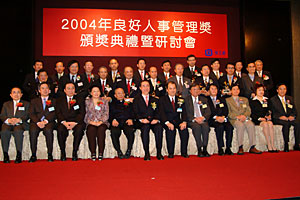 |
Financial Secretary
Mr Henry Tang Ying-yen (first row, sixth from left)
pictured with winners of Good People Management
Award. |
|
| |
|
Employee Rights and Benefits
Vigorous Enforcement against Illegal Employment
|
| 1.10 |
The Labour Department spared
no effort in combating illegal employment. We widely publicised
our 24-hour complaint hotline (2815 2200)
to collect more intelligence and launched more targeted
operations with the Police to apprehend illegal workers
and their employers on the spot. In the year, 104 joint
operations were mounted - 189 per cent over the corresponding
figure in 2003. As a result, a record high of suspected
illegal workers (760) and employers of these illegal workers
(196) were detected. On the publicity front, we produced
and distributed a new leaflet to households of large housing
estates warning against the employment of illegal domestic
helpers. |
| |
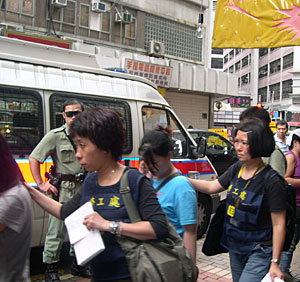 |
Labour inspectors
detecting illegal workers in a joint operation with
the Police. |
|
| |
|
Safeguarding the Rights
of Employees of Government Service Contractors |
| 1.11 |
In 2004, the Government implemented
further measures to ensure that non-skilled employees
of government service contractors received reasonable
pay. Starting from May 2004, contractors of service contracts
relying heavily on the deployment of non-skilled employees
were required to pay these employees at a rate not less
than the average monthly wages for the relevant industry/occupation
as published in the Census and Statistics Department's
latest Quarterly Report of Wage and Payroll Statistics
at the time when tenders were invited. In the year, the
Labour Department also stepped up inspections to the workplaces
of these employees to detect violations of labour laws.
Irregularities detected during inspections and offence
records of the contractors were passed to the relevant
procuring departments promptly for administrative sanctions
against offending contractors. |
| |
|
Voluntary Rehabilitation
Programme (VRP) for Employees Injured at Work |
| 1.12 |
In November 2004, we extended the pilot VRP for injured
employees in the construction industry to the catering,
transport and manufacturing industries so that more
injured workers could be benefited. The VRP was launched
in March 2003 on a pilot basis in the construction industry
with the objective of providing timely rehabilitation
services to injured workers for better and speedier
recovery, and facilitating their safe and early return
to work. The pilot programme has shown positive results
in achieving its objectives and has facilitated the
rehabilitation of 147 construction employees in its
first year of implementation.
|
| |
|
Protection of Wages on
Insolvency Fund Recording a Surplus |
| 1.13 |
As Hong Kong's economy further improved, the number
of applications for the Protection of Wages on Insolvency
Fund dropped from 22 350 in 2003 to 13 631 in 2004.
The fund recorded an average monthly surplus of $4.08
million in 2004 and registered an overall surplus of
$49 million by year-end, the first year that the fund
recorded a surplus since the Asian financial crisis
in 1997.
|
| |
|
Safety and Health at Work
Legislative Improvements on Container Handling Safety
and Safety Training
|
| 1.14 |
The Factories and Industrial
Undertakings (Safety Officers and Safety Supervisors)
Regulations were amended to extend coverage to the container
handling industry and enhance professionalism and training
of safety officers. The amendments were brought into full
operation in January 2004. To ensure that risks to workers'
safety and health are properly managed, we brought into
effect the Factories and Industrial Undertakings (Gas
Welding and Flame Cutting) Regulation in March 2004. This
requires any person performing gas welding and flame cutting
work to hold a valid certificate obtained after completing
a recognised training course. |
| |
|
Safety Award Schemes
|
| 1.15 |
Two safety award schemes were
organised in the catering and construction industries
to inculcate a safety culture and to enhance the safety
awareness of employers, employees and their families.
The schemes featured a variety of activities, including
open safety performance competitions, safety and health
seminars, roving exhibitions, site visits, radio programmes,
stickers, computer CD-ROM, broadcast of promotional films
on "RoadShow" and award presentation ceremonies
cum fun days. |
| |
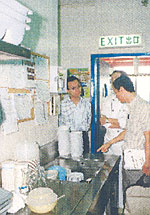 |
Adjudicators of
the Catering Industry Safety Award Scheme assessing
the safety and health performance of a participating
establishment. |
|
| |
 |
Permanent Secretary
for Economic Development and Labour (Labour) Mr
Matthew Cheung Kin-chung officiating at the Award
Presentation Ceremony of the Construction Industry
Safety Award Scheme. |
|
| |
|
Strengthening Local and International
Partnerships
Labour Day Reception
|
| 1.16 |
On 1 May 2004, the Secretary
for Economic Development for Labour hosted a cocktail
reception at Government House to celebrate Labour Day
and to pay tribute to the workforce. The reception was
officiated by the Chief Executive, Mr Tung Chee Hwa, and
attended by some 200 guests from trade unions, employer
associations and other organisations. |
| |
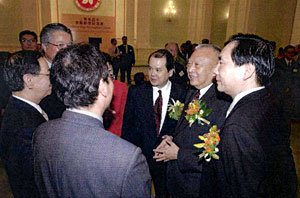 |
Chief Executive
Mr Tung Chee Hwa at Labour Day Reception. |
|
| |
|
Local Attachment Programme |
| 1.17 |
In 2003, the department arranged
short-term attachment programmes for its labour officers
to some of the leading corporations in the private sector;
including the MTR Corporation Limited, the Hong Kong &
China Gas Company Limited and Ernst & Young Transactions
Limited. In 2004, another attachment programme with the
Hongkong and Shanghai Banking Corporatioin Limited was
arranged for a labour officer. These programmes enabled
the officers to understand at first hand the culture and
business operation of private enterprises, particularly
in the area of human resources and corporate management.
They also facilitated mutual exchange of experience and
strengthened the department's networking with the private
sector. |
| |
|
Contacts with Other Labour
Administrations |
| 1.18 |
We maintain active liaison
and interflow with other labour administrations through
visits and participation in relevant activities. In April
2004, the Permanent Secretary for Economic Development
and Labour (Labour) led a delegation to attend the China
Employment Forum in Beijing and delivered a speech on
the youth employment programmes run by the Labour Department.
The Forum was organised by the Ministry of Labour and
Social Security and the International Labour Organisation. |
| |
 |
Permanent Secretary
for Economic Development and Labour (Labour) Mr
Matthew Cheung Kin-chung meeting Premier Wen Jiabao
at Zhongnanhai during his attendance in the China
Employment Forum. |
|
| |
|
| 1.19 |
In June 2004, a tripartite team
of government officials, employer and employee representatives
of the Labour Advisory Board attended the 92nd Session
of the International Labour Conference in Geneva to keep
themselves abreast of the latest development of international
labour standards. The occasion also strengthened their
rapport with counterparts in other countries and regions,
thereby facilitating future co-operation. |