Annual Report 2003
Chapter 6
Employee Rights and Benefit
The objective of the Employee Rights and Benefits Programme is to improve and safeguard employee rights and benefits in an equitable manner. Our aim is to progressively enhance employment standards in a way which is commensurate with the pace of Hong Kong's economic and social developments and to strike a reasonable balance between the interests of employers and employees. We achieve this by:
- setting and refining employment standards in consultation with the Labour Advisory Board (LAB), the most established consultative forum on labour matters;
- enforcing compliance with statutory and contractual terms and conditions of employment through inspection to workplaces and investigation into suspected breaches of the statutory provisions and prosecution of offenders;
- processing employee compensation claims;
- maintaining close partnership with statutory bodies set up for protecting the rights and benefits of employees; and
- providing customer-oriented information service to ensure that employees and employers know their rights and obligations.
 |
A labour inspector enforcing the Immigration Ordinance by checking an employee's proof of identity to deter illegal employment. |
The principal legislation administered by this programme area includes the Employees' Compensation Ordinance (ECO), the Pneumoconiosis (Compensation) Ordinance (PCO), the Employment Ordinance (EO) and its subsidiary Employment of Children Regulations and Employment of Young Persons (Industry) Regulations, as well as Part IVB of the Immigration Ordinance.
The ECO establishes a no-fault, non-contributory employee compensation system under which individual employers are liable to pay compensation for work-related injuries or fatalities. The ordinance requires all employers to possess valid insurance policies to cover their liabilities under the ordinance and at common law.
 |
A Concise Guide to the Employees' Compensation Ordinance. |
The PCO provides compensation to persons who suffer from pneumoconiosis. Compensation is paid from the Pneumoconiosis Compensation Fund, which is administered by the Pneumoconiosis Compensation Fund Board.
The EO is the main piece of legislation governing conditions of employment in the non-government sector. The Employment of Children Regulations made under the EO prohibit the employment of children below the age of 15 in industrial undertakings and regulate the employment of children aged 13 but under 15 in non-industrial establishments. The Employment of Young Persons (Industry) Regulations set out requirements on the working time arrangements for young persons employed in the industrial sector and prohibit their employment in dangerous trades.
The Labour Department also administers Part IVB of the Immigration Ordinance to combat illegal employment in order to protect the employment opportunities of local workers.
Our Work and Achievements in 2003
Key Indicators of Work
We stepped up our efforts to safeguard the rights and benefits of employees through various activities in 2003. Some key indicators of work of this programme area are shown in Figure 6.1.
Stepping Up Enforcement Against Wage Offences
The Labour Department takes a serious view on late payment and underpayment of wages and has put in place effective arrangements to enforce statutory provisions governing payment of wages. We conducted territory-wide blitz operations and inspections to workplaces such as construction sites, retail and catering establishments to detect wage offences. Labour inspectors actively interviewed employees during territory-wide routine inspections to combat offences, and the Employment Claims Investigation Unit conducted in-depth investigation into suspected wage offences under the Employment Ordinance promptly. Prosecutions are taken out against the employers once sufficient evidence is available.
 |
A labour inspector enforcing wage provisions at a catering establishment to ensure employees receive their wages on time. |
With stepped-up enforcement action in 2003, the number of summonses heard in respect of wage offences rose to 588, representing a marked increase of 197 per cent over the 198 summonses in 2002. As for summonses convicted, the number was 445 for 2003 as against 139 in 2002, an increase of 220 per cent.
Legislative Proposals to Preserve and Improve Employee Benefits and their Progress
In May 2003, the Occupational Deafness (Compensation) Ordinance was amended to improve the benefits of employees under the Occupational Deafness Compensation Scheme.
During the year, we continued with the drafting of the legislation for implementing the proposal to recognise Chinese medicine under the Employment Ordinance, Employees' Compensation Ordinance, Pneumoconiosis (Compensation) Ordinance and the Pneumoconiosis Ex Gratia Scheme.
Vigorous Enforcement Efforts
We have stepped up our enforcement efforts to ensure that the statutory rights of employees under labour legislation are well protected.
In 2003, labour inspectors carried out 156 919 workplace inspections to different economic sectors, including 154 129 inspections to combat illegal employment. (Figure 6.2) We strengthened the collection and analysis of intelligence on illegal employment activities, and organised more joint operations with the Police and the Immigration Department to apprehend illegal workers and their employers on the spot. We also publicised our complaint hotline to facilitate members of the public to provide intelligence on illegal employment activities. The new enforcement mode led to more effective results. A record high of 490 suspected illegal workers was detected in the year, representing an increase of 43.7 per cent over the corresponding figure in 2002.
 |
A joint operation to combat illegal employment. |
We mounted a territory-wide operation to retail establishments in the year to enforce the compulsory requirement of taking out employee compensation insurance policy under the Employees Compensation Ordinance. A total of 6 288 retail establishments was inspected in the exercise. Employers failing to comply with the statutory requirement were prosecuted.
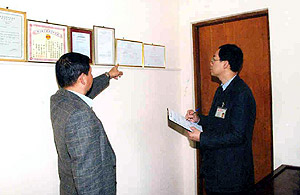 |
A labour inspector enforcing the Employees' Compensation Ordinance to ensure employers possess valid insurance cover for their employees. |
In the year, we continued to work closely with government departments in monitoring their service contractors to ensure that low-skilled employees of the contractors enjoyed their statutory rights and benefits. A total of 513 inspections was conducted to the workplaces of such workers and 2 064 workers were interviewed. Contractors found to have breached labour legislation were prosecuted and suspected breaches of contract terms were sent to concerned departments for administrative sanctions wherever appropriate.
 |
A labour inspector interviewing employees of a public housing security service contractor to understand their employment conditions. |
To ensure compliance with the required conditions under the Supplementary Labour Scheme, we investigated 53 complaints and cases on suspected irregularities such as late payment and underpayment of wages.
Processing Employee Compensation Cases
Under the current no-fault employee compensation system, compensation is payable to injured employees or family members of deceased employees for any work-related injuries or deaths. Claims for compensation involving fatality are determined by the courts or the Commissioner for Labour under the improved settlement mechanism introduced in August 2000.
Information on employee compensation cases reported was contained in Figures 6.3 and 6.4. In 2003, we processed 32 355 non-fatal cases involving sick leave exceeding three days which were reported in the year. These included 11 184 cases settled directly between employers and employees. Compensation amounting to $7.57 million and $269 million was payable respectively to the injured employees in minor cases and in cases involving sick leave exceeding three days.
For the 49 649 employee compensation cases reported in 2002, 47 220 non-fatal cases with sick leave exceeding three days and 156 fatal cases were settled as at the end of 2003. A sum of $804 million was payable as compensation to the injured employees or family members of deceased employees. The number of days lost was 1 281 501. (Figure 6.5)
The Loan Scheme for Employees Injured at Work and Dependants of Deceased Employees provides temporary relief to victims of work accidents. Under the scheme, an interest-free loan up to $15,000 in each case will be made to eligible applicants. In 2003, a total loan of $416,046 was approved in 34 applications.
Information and Advisory Services
Telephone Enquiry Service
We operate a round-the-clock Telephone Enquiry Service (TES) to handle general enquiries on labour legislation and labour matters. Members of the public can listen at any time to 80 topics of pre-recorded messages in Cantonese, Putonghua or English on labour legislation and services of the department. They can also obtain 93 forms and printed messages in Chinese or English by fax. During office hours, telephone enquiry officers are available to answer further enquiries. In the year, this highly popular service handled 1 187 809 calls. (Figure 6.6)
 |
Telephone enquiry service officers providing one-stop enquiry service to the public on labour ordinances and the services of the department. |
Briefings and Promotional Campaigns
In 2003, we arranged four briefings for the public sector and 55 briefings for imported workers to publicise the rights and obligations of the parties concerned.
Extensive publicity campaigns were launched to warn against illegal employment and to educate employers and employees about their rights and obligations under the Employees Compensation Ordinance .
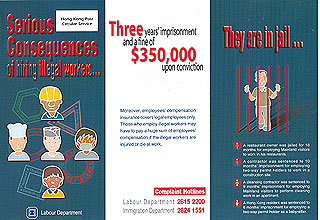 |
Promotional leaflet against illegal employment. |
 |
Posters and leaflets publicising the requirement on timely payment of compensation by employers under the Employees' Compensation Ordinance. |
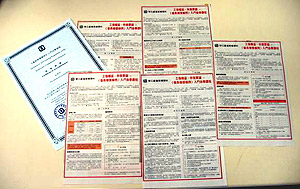 |
"Introductory Self-learning Programme on the Employees' Compensation Ordinance" was launched in the Ming Pao to enhance public understanding of the Ordinance. |
 |
Seminars on the Employees' Compensation Ordinance were effective in enhancing participants' understanding of the Ordinance and the procedures in processing employees' compensation cases. |
Partnership with Statutory Bodies
We maintain close partnership with various statutory bodies to administer the various schemes for the protection of the rights and benefits of employees.
Protection of Wages on Insolvency Fund Board
The Protection of Wages on Insolvency Ordinance (PWIO) provides for the establishment of the Protection of Wages on Insolvency Fund (the Fund) and its administration by a board. Under the PWIO, employees who are owed wages, wages in lieu of notice and severance payments by their insolvent employers may apply to the Fund within six months after their last day of service for ex gratia payments.
We support the Protection of Wages on Insolvency Fund Board by verifying applications and approving payments from the Fund. In 2003, we received 22 350 applications and processed a record high of 22 042 applications, leading to payments of $468.2 million. A breakdown of applications received by economic sectors was shown in Figure 6.7. Although the Fund Board secured a government bridging loan of $695 million in 2002, it was not necessary to draw down the loan in the year.
The department and the Fund Board take a serious view on possible abuse of the Fund, particularly with employers dishonestly shifting their liabilities on wage payments to the Fund. Stringent vetting procedures are in place to process all applications. An "inter-departmental task force" comprising representatives of the Labour Department, Official Receivers Office, Commercial Crime Bureau of the Police Force and Legal Aid Department has been set up to further prevent possible abuse.
Pneumoconiosis Compensation Fund Board
The Pneumoconiosis Compensation Fund Board (PCFB) is established under the Pneumoconiosis (Compensation) Ordinance (PCO) to provide compensation to persons suffering from pneumoconiosis. The Board is financed by a levy collected from the construction and quarrying industries. Under the PCO, the Labour Department is responsible for determining whether an applicant is entitled to compensation. Eligible persons receive compensation in the form of monthly payments from the PCFB. In 2003, the Board approved 2 089 applications, leading to payments of $171.3 million.
Employees Compensation Assistance Fund Board
The Employees Compensation Assistance Fund Board (ECAFB) is set up under the Employees Compensation Assistance Ordinance (ECAO). The ECAFB is responsible for running the Employees Compensation Assistance Scheme which provides payments to injured employees who are unable to receive their entitlements for employment-related injuries from their employers or insurers. The scheme also protects employers in the event of the insurers underwriting their employees' compensation insurance becoming insolvent. In 2003, the Board approved 769 applications, leading to payments of $126.7 million.
Occupational Deafness Compensation Board
The Occupational Deafness Compensation Board is established under the Occupational Deafness (Compensation) Ordinance to provide compensation and reimbursement of expenses incurred in purchasing, repairing and replacing hearing assistive devices to those persons who suffered from noise-induced deafness due to employment in specified noisy occupations. In 2003, the Board received 213 applications for compensation and approved 74 applications with a total compensation payout at about $6.95 million. The Board also received 201 applications in relation to the payment of expenses on hearing assistive devices and approved 119 applications with a total approved amount of about $0.72 million.