Annual Report 2003
Chapter 4
Safety and Health at Work
The Occupational Safety and Health Branch is responsible for the promotion and regulation of safety and health at work. The objective of the Programme of Safety and Health at Work is to ensure that risks to people's safety and health at work are properly managed and reduced to the minimum by legislation, education and promotion. More specifically, we achieve the objective by:
- providing a legislative framework to safeguard safety and health at work;
- ensuring compliance with the Occupational Safety and Health Ordinance (OSHO), the Factories and Industrial Undertakings Ordinance (FIUO), the Boilers and Pressure Vessels Ordinance (BPVO) and their subsidiary regulations by conducting inspections and taking out regulatory actions;
- investigating accidents and occupational health problems at workplaces;
- improving the knowledge and understanding of employers, employees and the general public on occupational safety and health by providing them with appropriate information and advice; and
- organising promotional programmes and training courses to improve safety awareness of the workforce.
 |
 |
 |
 |
 |
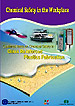
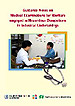
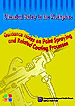
Code of Practice and Guidance Notes. | ||||
The principal legislation for safety and health at work includes the OSHO, the FIUO, and the BPVO.
With few exceptions, the OSHO protects employees' safety and health at work in practically all branches of economic activities. It is basically an enabling legislation that empowers the Commissioner for Labour to make regulations prescribing standards for general working environment as well as specific safety and health aspects at work.
The FIUO regulates safety and health at work in industrial undertakings, which include factories, construction sites, cargo and container handling areas, as well as catering establishments.
The BPVO aims at regulating the standards and operation of equipment such as boilers, pressure vessels, including thermal oil heaters, steam receivers, steam containers, air receivers and pressurised cement tanks mounted on trucks or trailers.
Our Work and Achievements in 2003
Continuous Improvement in Safety Performance
Hong Kong's occupational safety and health performance continued to improve in 2003, with notable performance in the construction and catering industries.
For statistics on occupational safety and health, please visit the following webpage: http://www.labour.gov.hk/eng/osh/content10.htm.
Key Indicators of Work
Some key indicators of work of this programme area are shown in Figure 4.1.
Legislative Improvements
In 2003, we amended the Construction Sites (Safety) Regulations to extend the duties imposed on the principal contractor of a construction site to other contractors who control the way any construction work is carried out on the site. To go with this amendment, the Factories and Industrial Undertakings (Lifting Appliances and Lifting Gear) Regulations, the Factories and Industrial Undertakings (Suspended Working Platforms) Regulation and the Factories and Industrial Undertakings (Loadshifting Machinery) Regulation were also amended to extend the duties of the principal contractor to other contractors who control the way any construction work involving the use of these equipment or machinery is carried out on the construction site. These amendments will help improve the safety performance of construction sites.
Law Enforcement
To secure safety and health at work, we inspect workplaces, monitor health hazards, investigate work accidents and occupational diseases, register and inspect boilers and pressure equipment and advise on measures to control hazards or prevent recurrences.
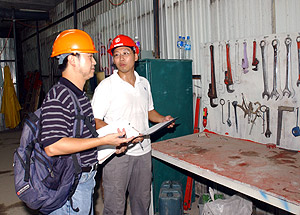
A key element in enforcement is to advise on prevention of accidents. We conducted special promotional visits to encourage employers to adopt a self-regulatory approach in managing risks at the workplace. A number of special blitz operations were also organised on safety of working-at-height, scaffold, container handling, gas welding and flame cutting, fire and chemical, and plant and machinery. The operations on safety of working-at-height and scaffold focused on the external renovation work of buildings. Through these operations, renovation contractors were urged to take adequate safety precautions to ensure the safety at work of their workers.
 |
|
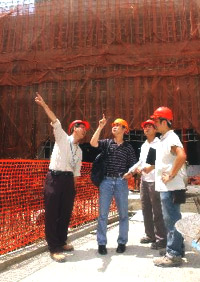 |
Blitz operations. |
We continued to target at establishments with poor safety performance for close surveillance. Improvement notices or suspension notices were issued when necessary to secure a speedy rectification of irregularities, or to remove imminent risk to lives and limbs. Many of these companies, especially those in the construction industry, have shown significant improvements in their safety performance. In the light of the SARS epidemic in the year, we enhanced the inspection of high-risk workplaces including hospitals, elderly homes and workplaces undergoing cleaning and disinfection to ensure that adequate preventive measures were taken to reduce the risks of infection of workers.
The Commissioner for Labour, as the Boilers and Pressure Vessels Authority, recognises competent inspection bodies to assess and inspect new pressure equipment during manufacturing. As at the end of 2003, there were 31 appointed examiners and six recognised inspection bodies. We also conduct examinations, monitor courses for training of competent persons and issue certificates of competency to qualified candidates as competent persons for various types of boilers and steam receivers. In 2003, 496 candidates were examined, of whom 425 were awarded certificates of competency. We also advise the Fire Services Department on approval and preliminary inspections of pressurised cylinders and storage installations for compressed gas.
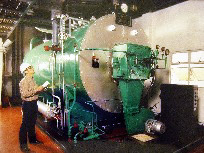 |
Inspection on the operation of an automatic fire-tube boiler. |
As at 31 December 2003, a total of 153 730 workplaces, including 13 217 construction sites was recorded. In 2003, 124 833 inspections were conducted under the OSHO and the FIUO, while 6 494 inspections were made under the BPVO. 36 394 warnings were issued by Occupational Safety Officers while 4 120 warnings were given under the BPVO. Altogether, 1 440 suspension or improvement notices were issued. We also carried out 11 866 and 2 948 investigations on accidents and suspected occupational diseases respectively in the year. Among the suspected occupational diseases, 258 cases were confirmed.
Safety Training and Occupational Health Education
We provide training-related services to help industry reduce occupational injuries. Such services are divided into three broad categories, namely training courses, accreditation of external training providers and registration of safety officers and safety auditors.
In 2003, we conducted 518 training courses on safety legislation for 4 336 participants and 269 tailor-made safety briefing sessions for 8 641 employees. We also accredited 29 mandatory basic safety training courses for the construction and the container-handling industries. As at the end of 2003, more than 632 000 persons have completed the training. We also accredited 38 confined spaces safety training courses, six loadshifting machinery safety training courses and three gas welding and flame cutting safety training courses.
In 2003, 95 applicants were registered as safety officers while 132 applicants were registered as safety auditors. As at the end of 2003, there were 2 520 persons on the register of safety officers and 622 persons on the register of safety auditors.
Occupational health education is an important strategy for the control of occupational health hazards and prevention of occupational diseases. Apart from the conventional way of organising health talks at our own premises, we have also developed outreaching services for occupational health education by delivering talks at the venues of individual companies or organisations. In 2003, we delivered a total of 2 153 health talks.
Safety Promotion
To inculcate a safety culture and to enhance safety awareness, we organised various promotional activities in 2003, some in conjunction with other organisations such as the Occupational Safety and Health Council, trade associations, workers unions and other government departments.
The well-received Catering Industry Safety Award Scheme and the Construction Industry Safety Award Scheme were organised again in the year. Campaigns were also launched to promote and publicise amendments to the Factories and Industrial Undertakings (Safety Officers and Safety Supervisors) Regulations, the Factories and Industrial Undertakings (Gas Welding and Flame Cutting) Regulation, the importance of rest breaks at work and the safety of working at height.
The Occupational Safety Charter was jointly launched with the Occupational Safety and Health Council in 1996 to promote the spirit of 'shared responsibility' in workplace safety and health, as well as setting out a safety management framework for employers and employees to work together to create a safe and healthy working environment. By the end of 2003, 737 organisations, including public utilities companies, industrial and non-industrial establishments, construction companies, unions and associations, had subscribed to the Occupational Safety Charter.
Publicity and Advisory Service
In 2003, 25 new occupational safety and health publications were published, including a code of practice for working with display screen equipment, casebooks on occupational disease and fatalities, and four guidance notes respectively on medical examinations for workers engaged in hazardous occupations in industrial undertakings, chemical safety in textile finishing, glass reinforced plastics fabrication, and paint spraying and related coating processes.
 |
 |
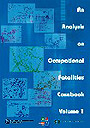 |
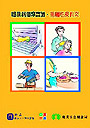
Occupational Disease Casebooks (Chinese Version only) and Occupational Fatalities Casebook. | ||
In 2003, we handled 25 837 enquiries, advising on various occupational safety and health matters. One-stop information and advisory services are provided to workers and employers at the Occupational Safety and Health Centre.
Medical and Clinical Services
Our medical and nursing staff at the Occupational Health Clinic provides clinical consultations, medical treatment as well as occupational health education and counselling services for workers suffering from work-related diseases. The workplaces of the patients are inspected if necessary to identify and evaluate occupational health hazards in the work environment. We also assess the medical fitness for work of radiation workers, aviation personnel and government employees exposed to specific occupational health hazards.
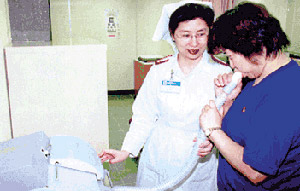 |
Medical assessment. |
In 2003, 7 039 clinical consultations were rendered, and 2 643 medical examinations and assessments performed. Ten patient support groups were organised to promote patients treatment compliance and sustainability in good work practices through health talks, experience sharing and peer support.
Improved Application of Information Technology
In 2003, we continued to improve our electronic databank that contained information on occupational accidents, safety and health legislation, legal advice and reference materials. The Occupational Safety and Health Management Information System was also put into operation in 2003. The system facilitated communication and information sharing in and between the Headquarters and regional offices.