Publications
Labour Department Environmental Report for 2005
Introduction
This report covers the environmental performance of the Labour Department for the year 2005.
The Labour Department and its Services
The Labour Department (LD) is the principal agency in the Government of the Hong Kong Special Administrative Region responsible for the execution and co-ordination of major labour administration and occupational safety and health functions. Its aim is to enhance the well-being of the workforce progressively and promote the safety and health of those at work. It has four key areas of work: Labour Relations, Employment Services, Safety and Health at Work and Employee Rights and Benefits.
As at 31 December 2005, the Department had an establishment of 1 730 posts, accommodated in 34 office locations throughout the territory. The actual expenditure of the Department in 2005-06 was $939 million, covering $795 million recurrent expenditure and $144 million non-recurrent expenditure.
Our Environmental Policy and Measures
The LD is committed to environmental protection by acting in compliance with the relevant legislation and codes of practices as well as providing a green environment for staff and members of the public visiting its offices. The following policies have been adopted in pursuit of such commitment: -
-
Implementation of Green Housekeeping Measures
The Department has implemented a series of green housekeeping measures under the Green Management Scheme, targeting at minimisation of resource consumption, waste recovery and energy conservation, and closely monitors their effectiveness. A detailed account of the measures taken is annexed for general information.
-
Training and Publicity amongst Staff
Through promotional and educational programmes, the Department aims at ensuring that all staff members are aware of their environmental responsibilities. Departmental guidelines are reviewed and re-circulated regularly to publicize green management. The Department also coordinates and encourages its staff to participate in environmental activities including the "Community Chest Green Day" and various environmental fund-raising events and green management seminars organized by other bureaux/departments or outside organizations, with a view to promoting their environmental awareness. Besides, staff members are also encouraged to make suggestions on green initiatives.
-
Review of Office Practices
The Department takes a proactive approach in reviewing office practices which are not environment-friendly and introduces new improvement measures whenever feasible.
-
Minimising Environmental Pollutants
The Department observes the guidelines on infection control issued by the Department of Health in disposal of the clinical wastes of its Occupational Health Clinics, and takes every measure to minimise the production of environmental pollutants and/or nuisance. Chemical wastes from the Occupational Hygiene Laboratory are collected by specialized waste collector. Asbestos wastes produced by the Laboratory are disposed of by appointed asbestos waste collector as required.
As the Department attaches great importance to environmental protection, a committee comprising directorate officers has been established to oversee the Department's environmental policy and performance. The committee has directed its efforts at various levels to achieve the objective of maintaining a green office environment. With increasing environmental consciousness amongst our officers and their support, good progress has been made in this regard.
Performance
Paper Consumption
Electricity Consumption (See Note)
Note :
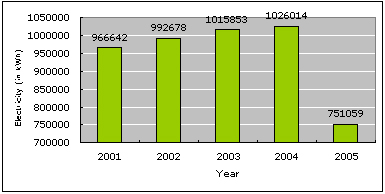
(1) The figures only represent the electricity consumption of the LD's offices in leased premises for which the Department is responsible for paying the electricity bills. Electricity consumption of LD's offices in multi-user buildings managed by the Government Property Agency (GPA) and other Departments, which we are not able to work out our share in consumption, is not covered in this report.
(2) Due to changes in office accommodation, the Department had in 2005 13 electricity meters in leased premises, the bills of which were paid by the Department, and the total electricity consumption recorded by these 13 meters was 751 059 kWh. In 2004, the Department had 18 electricity meters in leased premises recording a total electricity consumption of 1 026 014 kWh. Of these electricity meters, only 10 were used for a full year in both 2004 and 2005. Any meaningful comparison of the electricity consumption in these two years should therefore be done on the basis of the full-year electricity consumption recorded by these 10 electricity meters in 2004 and 2005, and not the other meters. The full-year electricity consumption recorded by these 10 electricity meters in 2004 and 2005 stood at 729 232 kWh and 704 854 kWh respectively. This suggested that at least for the offices covered by these 10 electricity meters, if not the others, electricity consumption had dropped by 3.3% from 2004 to 2005.
Along with globalisation, Hong Kong is facing the challenges brought about by economic restructuring. Despite continued improvement in the employment market, with the unemployment rate coming down from a record high of 8.6% in mid-2003 to 5.3% at the end of 2005, employment continues to be a subject of public concern. With a proactive and pragmatic approach and given united efforts, the Labour Department has achieved notable results in various programme areas, including a record-high number of job placements (113 090) and vacancies (432 314) solicited from the private and public sectors; a record-high settlement rate of 69.8% for conciliation of disputes and claims since 1994; an increase of 16.5% in the number of convictions for summons on wage offences over 2004; and an increase of 69% in the number of operations mounted against illegal employment over 2004. In addition, the Department launched two new initiatives in the year, namely the Work Trial Scheme and the Work Orientation and Placement Scheme. The former aims to enhance the employability of job-seekers who have special difficulties in finding jobs; while the latter provides disabled job-seekers with pre-employment training and encourages employers to take on people with disabilities.
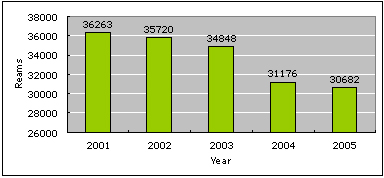
Notwithstanding the persistently heavy workload, the Department continued to perform well in reducing paper consumption in 2005, achieving a further reduction of 1.6% over 2004. Besides, the Department's performance in energy saving in 2005 was also encouraging. As reflected in the electricity consumption recorded by the 10 electricity meters under the Department's account which were used throughout 2004 and 2005, the Department has achieved a saving of 3.3% in electricity consumption compared with 2004.
Looking ahead, the Department will sustain its effort in green management. It will continue to encourage all staff members to take all possible measures in waste minimization and energy conservation and to explore new ideas for operating in an environmentally friendly manner.
Feedbacks and Comments
If you have any comments or suggestions on this report, please send them to
the Green Manager of the Department at:
Mail: 17/F, Harbour Building, 38 Pier Road, Central, Hong Kong
E-mail: enquiry@labour.gov.hk
Fax: 2544 3271
Annex
Green Housekeeping Measures Taken
Minimising Paper Consumption
-
Using both sides of paper -
Internal circulars have been issued to staff members encouraging them to write and print on both sides of each piece of paper. -
Minimising copies of circulars -
In 2005, all circulars of the Department continued to be disseminated to staff members by means of e-mail. By doing so, a saving of approximately 1,200 reams of paper was achieved per year. -
Communicating by e-mails -
The Department has completed enhancement of communication among staff by extending its e-mail network to all the branch offices. By the end of 2005, 516 staff members have been provided with individual e-mail accounts. The remaining staff could also have access to the e-mail network through the shared use of 218 e-mail accounts. -
Implementing Departmental Portal -
The Department launched the Departmental Portal since May 2004 to provide a platform for e-transactions within the Department, including on-line access to the e-Payroll System of the Treasury and the e-Leave System for handling leave application, thereby reducing in paper consumption as paper-based payroll slips and leave application forms were no longer required for most staff. -
Adopting electronic version as the mode of publication -
The Department has continued to adopt electronic version as the mode of publication for the Department's major publications in 2005. Relevant parties concerned, including members of the public, could easily access these electronic publications through the Department's websites. Examples of these include the Annual Departmental Report (with more than 100 A4 pages, printed on both sides in full colour) and the departmental staff newsletter, Staff Times (with about four to eight A4 pages, printed on both sides in full colour). The adoption of electronic version for these two publications enabled us to achieve reduction in paper consumption of around 13,000 hardcopies per year. -
Exchanging softcopies / diskettes within and outside Department -
The Department has successfully established a culture in which officers will minimize the printing of hardcopies by communicating through e-mail or transfer of softcopies on diskettes. -
Minimising photocopies -
Starting from 2000, documents like Government gazette notices and internal proforma have been uploaded to the Government Office Automation Network for common viewing and access through the network to reduce printed copies. -
Using plain paper fax machines -
The Department has fully adopted the use of plain paper fax machines since 2000. -
Using double-side photocopiers -
All photocopying machines in the Department have been equipped with the double-side photocopying function since 2005. -
Avoiding the use of fax leader pages -
Staff members are encouraged to use fax notes instead of cover sheets for outgoing faxes. -
Retaining original documents for circulation -
For those documents like departmental orders that require routine re-circulation, the original sets of documents would be preserved for re-use.
Minimising the Use of Stationery
-
Using refillable ball pens -
All staff members are provided with refillable ball pens for their daily work. -
Minimising the use of envelopes -
Staff members are encouraged to minimise the use of envelopes. The consumption of envelopes reduced from 1,256,560 in 2002 to 1,064,007 in 2005. -
Minimising the use of loose minute jacket -
Staff members are encouraged to re-use loose minute jackets whenever practicable. -
Re-using decorative materials -
Serviceable decorative materials have been kept for re-use since 1998. -
Using CD-RWs for record storage instead of CD-Rs -
Except for records which needed to be kept for long-term would be saved in CD-Rs (Compact Discs - Recordable), CD-RWs (Compact Discs - Rewritable) which allow re-use are used as the storage media for most electronic records.
Waste Recovery
-
Using the blank side of used paper for drafting or printing of internal
documents -
Boxes are provided in all offices to collect paper, which has been used on one side only, for drafting purpose. Internal documents like departmental orders, advisory memoranda, circulars and file copies are printed on the blank side of used paper. -
Collecting waste paper for recycling -
In 2005, 22,806 kg of waste paper was collected by the Department for recycling, excluding those in multi-user government buildings which were collected through contractors employed by the GPA. -
Using recycled paper -
About 99.5% of the paper consumed by the Department in 2005 was recycled paper. -
Collecting obsolete personal computers -
Over 1,000 sets of personal computers were collected for recycling through the Government Logistics Department's contractors in the past five years. -
Redeploying serviceable furniture and equipment-
57 pieces of serviceable furniture were successfully redeployed for further usage in 2005. -
Collecting used toner cartridges-
Toner cartridges for laser printers were collected and returned to suppliers for recycling. In 2005, 670 used laser cartridges were collected.
Energy Conservation
- Switching off electrical appliances when not in use;
- Adopting the use of high efficiency lighting equipment. Among others, our offices in Revenue Tower and Cornwall House were successfully registered in the Hong Kong Energy Efficiency Registration Scheme for Buildings since 2004 and 2005 respectively, as a recognition to their compliance with the Code of Practice for Energy Efficiency of Lighting Installations;
- Adjusting the illumination of lighting equipment to the minimum required level;
- Adjusting the air-conditioning system with a view to keeping the room temperature to 25.5oC in summer months in line with the advice of the Environment, Transport and Works Bureau for all offices except those which need to set the temperature at a lower level for operational reasons;
- Installing thermometers in all offices to closely monitor the room temperature to ensure that it will be kept at 25.5oC in summer months;
- Encouraging staff to use staircase, instead of lifts/escalators, for inter-floor traffic;
- Affixing 'Save Energy' stickers to power switches to remind staff to turn off air conditioning units/lighting not in use or keep them at suitable settings;
- Requesting all officers to set their personal computers at hibernation/standby mode which saved about 75% of electricity consumption when compared to computers stayed at normal mode, where appropriate;
- Appointing Energy Wardens in all locations to monitor the effective implementation of energy saving measures; and
- Procuring LCD monitors instead of CRT monitors when replacement of monitors is required.
Extended working hours and the extensive use of information technology have created challenges in reducing energy consumption. With our concerted effort in adopting the above various measures in energy conservation to meet the challenges, we have managed to achieve a 3.3% saving in electricity consumption in our offices in leased premises when compared with 2004 as reflected by the 10 electricity meters under the Department's account which were used for a full year in 2004 and 2005.